Skip to content
Send an e-mailMessage us on WhatsAppLinkedInInstagramFacebookRequest a Quote
+90 332 226 07 76Message us on WhatsApp
Big Bag Filling Machines

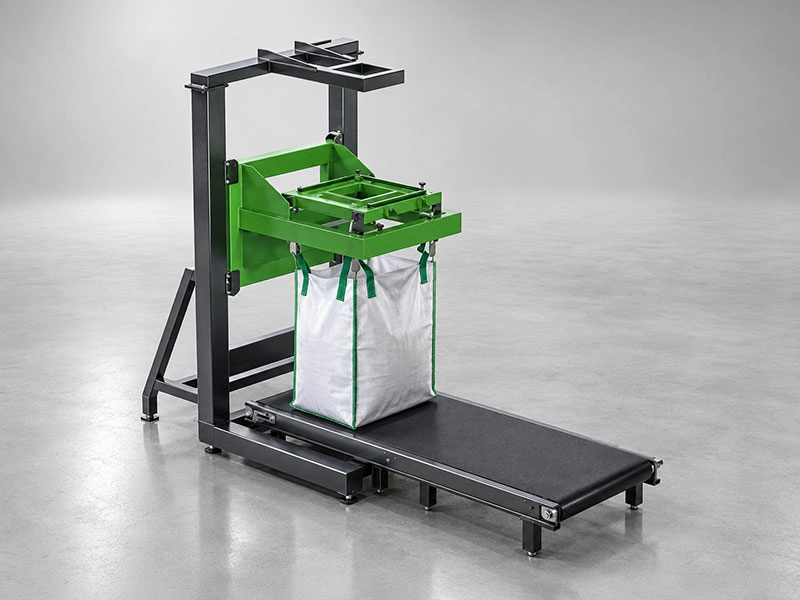
BBF Big Bag Filling Machine

The BBF big bag filling machine is an automatic filling system that loads powdered and granular products into big bags of 500–2000 kg while weighing them. The operator fits the bag and starts the cycle; fast filling, the fine finish, tare and hook release are handled by the machine. It is designed for plants that ship seed, feed, flour, sugar, fertiliser, plastic granules, sand or perlite by the tonne.

Capacity
15 – 30 Ton / h

How does a filling cycle run on the BBF?

The operator’s part ends with preparing the bag. The top spout of the empty bag is slipped over the machine’s filling head, the loops go onto the hooks and the cycle is started from the panel. From there the BBF takes over: feeding opens at full rate and most of the bag is filled within a short time. Once the reading gets close to the value entered on the panel, the machine switches by itself to slow, fine feeding, so the last kilograms arrive in a controlled stream. When the target is reached, feeding stops and the hooks open automatically to release the bag.

The full bag leaves the station on a roller conveyor or by forklift and goes on to storage, dispatch or the next process. Because the hooks open by themselves, nobody has to stand next to a heavy bag and undo the loops one by one. That saves a few seconds on every cycle and also cuts the time spent close to a suspended load.

What is set on the panel?

The BBF is operated from a touch panel. Values such as target weight and acceptance tolerance are stored as a recipe for each product; when the product changes, the operator simply picks the matching recipe. In a plant that fills fertiliser in the morning and premix in the afternoon, nobody has to retype the settings each time, and the risk of starting a run with the wrong values goes down.

The panel also makes order-based work easier. If a customer is to receive 24 bags, the required bag count is entered and filling ends when that count is complete. The total filled weight and the number of bags are shown on screen, so at the end of a shift you can read how many tonnes went into how many bags without a separate count. Menus and warning messages are available in Turkish and English.

Tare, error correction and tolerance alarm

With large bags, the last kilograms are the hardest part. Even at the moment feeding stops, there is product in the air between the filling head and the bag, and as it lands the weight can creep slightly past the target. The BBF has an automatic function that monitors and corrects this weighing deviation at the end of filling. Tare is also taken automatically for every bag, so the weight of the empty bag, and of any inner liner, does not end up in the product weight.

If a bag still falls outside the accepted band, the machine does not move on to a new cycle; it holds and raises a warning. An under- or overfilled bag therefore cannot slip into dispatch unnoticed. The operator checks the bag, makes the correction, and work resumes. The limits at which the warning is given are set in the recipe according to the value of the product and what the buyer expects.

Feeding method and auxiliary equipment

How the product reaches the bag depends on how freely it flows. Gravity feeding suits seed, grain and plastic granules that run under their own weight; a belt conveyor suits product that arrives from a conveyor line or flows unevenly; a screw conveyor is preferred for powders such as flour and premix that tend to pack. Where the flow needs to stay continuous and steady, a vibrating mechanism can be added to the feed. If the product has to settle fully inside the bag, a vibrating platform is placed where the bag stands.

The choice depends on the plant layout as well as on the product. For a very light, bulky material like perlite, settling by vibration and choosing a bag volume that matches the density come first. For heavy, abrasive materials such as sand and gravel, the question is rather how the feed spout and gates will be protected against wear.

Reading the capacity for your own plant

The figures given for the BBF are 15–30 big bags per hour and 15–30 tonnes per hour; with 1000 kg bags the two ranges match. Where you land within that range depends on the product’s flow, the way the machine is used and the pace at which operators fit and remove bags. A simple calculation is enough to test your own target: say 240 tonnes are to be bagged over two shifts a day; over 16 working hours that calls for 15 tonnes an hour. With 1000 kg bags that is 15 bags an hour, the bottom of the range. If the same tonnage has to fit into a single shift, the need rises to 30 bags an hour and moving full bags away on a conveyor becomes part of the discussion. Sending us your product, bag weight and daily target is enough for us to propose a suitable feed arrangement. We reply to quotation requests within 3–4 hours.

Key features

Touch panel with recipes

Target and tolerance values are stored per product; on a product change the saved recipe is selected and filling starts straight away.

Auto tare and fill correction

Every cycle subtracts the empty bag by itself, and the weighing deviation at the end of filling is corrected by the machine.

Total tonnage and bag counter

Total filled weight and bag count are shown on the panel, so output can be read without counting separately.

Preset bag count

The required number of bags is entered; filling stops once the order quantity is complete.

Hold and alarm on tolerance

If a bag ends up outside the accepted band, the machine holds the cycle and alerts the operator.

Turkish and English menus

Menus and warning messages are available in both languages.

Technical Specifications

Touch panel, making prescriptions
Automatic tare and weighing error correction process
Total weight and total number of bags monitoring
Ability to buy any number of bags
Waiting and warning if the weight is out of acceptable tolerance
Turkish and English menu warning messages
Capacity: 15 – 30 Ton / h

Applications

  • Food and Chemical Production
  • Agriculture
  • Petrochemicals
  • Construction and Mining

Frequently asked questions

Who takes the bag off the hooks when filling ends?

When the target weight is reached, feeding stops and the hooks open automatically. The operator does not have to undo the loops by hand; the full bag is handed straight over to a roller conveyor or a forklift.

How many tonnes per hour does the BBF fill?

Capacity is 15–30 tonnes per hour. Free-flowing granules and layouts that clear full bags quickly approach the upper figure; hard-to-flow powders and layouts where bags are removed one at a time by forklift move towards the lower one.

How do I fill a fixed number of bags?

Enter the required bag count on the panel. The machine counts each bag and finishes filling when the count is reached. Since the total filled weight is shown on the same screen, the shipment quantity does not need to be worked out separately.

What happens if a bag ends up out of tolerance?

The BBF does not move on to the next cycle; it holds and gives a warning. The operator checks and corrects the bag, then filling continues from where it stopped. A bag with the wrong weight therefore does not leave for dispatch unnoticed.

Can very light products such as perlite be filled?

Yes, perlite is among the BBF’s applications. With very light products the same weight takes up a large volume, so the bag size is chosen to suit the density, and a vibrating platform can be used to settle the product fully in the bag.

How do I know which feeding type I need?

Check whether your product runs out of the silo on its own. If it flows freely, gravity feeding is usually enough; if it arrives by conveyor, a belt is considered, and if it bridges or forms lumps, a screw conveyor. Telling us the product name and its density is a good starting point for the decision.

Request a Quote

Quote requested forBBF Big Bag Filling Machine

Big bag weight (optional)

Your details are used only to reply to your request. Privacy Notice

Still with you after installation

Send repair, maintenance and calibration requests through the Technical Service page or by phone.

Technical service request