Skip to content
Send an e-mailMessage us on WhatsAppLinkedInInstagramFacebookRequest a Quote
+90 332 226 07 76Message us on WhatsApp
Bagging Machines

M-DB2-2L Two-Station Double Belt Bagging Machine Pro

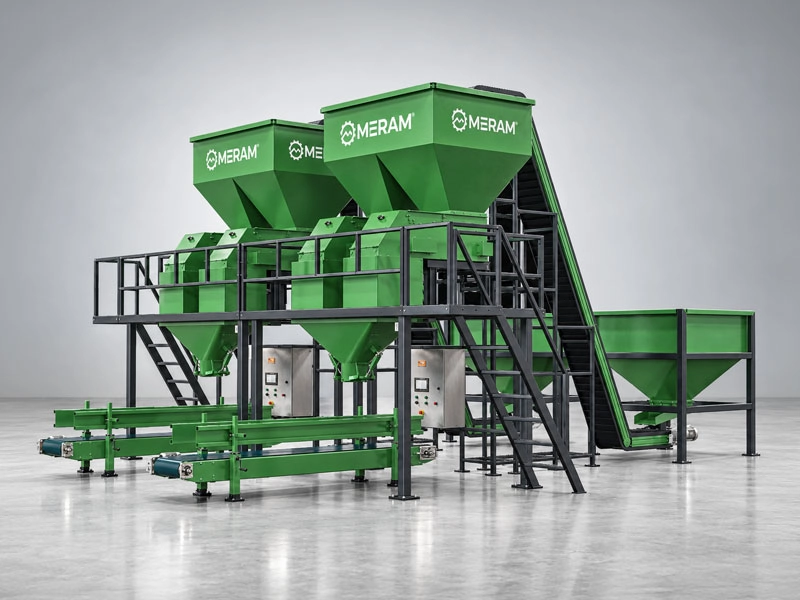
The M-DB2-2L two-station double belt bagging machine is a professional filling line that bags pellets, coal, pumice and similar coarse materials at two separate filling stations working in turn. Depending on the product it delivers 400–750 bags an hour and weighs 25–50 kg bags to within ±50–150 g. It is built for pellet plants, coal yards and pumice quarries where putting bags on at a single spout holds the line back.

Weighing range
25 – 50 Kg
Output capacity
19 – 22 / 17 – 19 t/h
Weighing accuracy
± 50 – 150 gr
Request a quotation

How do the two stations alternate?

A 3,000-litre hopper sits on top of the machine. Product drops from it onto two feed belts that carry it to the weighing section; the belts run together for fast coarse filling, and as the target nears the stream is eased off so the final kilos go in under control. Weighing is done by load cells, and the target weight and settings are entered on a touch-screen operator panel.

The difference lies on the filling side. The M-DB2-2L has two filling stations side by side, and the weighed product is sent to them in turn. While the bag at the first station is filling, the operator at the second station fits an empty bag onto the spout and shuts the clamp. When filling ends and the turn changes, the roles swap: the full bag is released and the ready bag at the other station starts filling. The weighing section therefore never waits for a bag to be fitted; the preparation time of one bag passes while the other bag is being filled.

Where does the extra output come from?

On a single-spout bagging machine, the time spent on each bag has two parts: the filling time in which product flows into the bag, and the manual work of fitting the empty bag and taking the full one off. During the second part the belts and weighing section usually stand idle. However quickly the machine weighs, the line does not move until the operator has the next bag on the spout.

A simple sum shows it. 750 bags an hour means one bag every 4.8 seconds (3,600 / 750 = 4.8). At a single spout, both filling and the bag change have to fit into that short window. When two stations work in turn, each takes about 375 bags an hour, which leaves a cycle of 9.6 seconds per bag at each spout. The operator can fit the bag without rushing, while the weighing section moves straight on to the next bag.

Converted to tonnes, the result agrees with the technical table. For example, 750 bags of 25 kg an hour comes to about 18.75 tonnes (25 x 750 = 18,750 kg). The table gives output as 19–22 or 17–19 tonnes an hour, depending on the product. With heavier bags the bag count falls, but because each fill takes longer the hourly tonnage stays close. In short, what the second station buys you is that the machine’s weighing speed is not lost to bag changes.

How it differs from the M-DB1 and who it suits

The single-station M-DB1 also runs on two belts and has the same bag range in its table. The distinction is how often the top of that range can be reached in daily operation. At a single spout, pace depends heavily on how quickly the operator can fit bags. The M-DB2-2L splits that work between two spouts and makes the line far less dependent on human pace. Where one operator can hold the rhythm and there are no long shifts without breaks, the M-DB1 is the simpler choice and takes up less floor space.

  • Pellet plants: facilities running in shifts where output from the press line has to be bagged without pause. Two stations make it easier for the filling point to keep up with the press.
  • Coal yards and packing facilities: businesses preparing thousands of bags a day during the busy pre-winter dispatch season. Bagging dusty product quickly also shortens the time it stands in the open.
  • Pumice quarries: sites where a light, abrasive product is bagged in large volumes. Belt feeding carries coarse, angular grains without trapping them in a gate.
  • Similar coarse products: bulk materials that travel easily on a belt and may flow unevenly. Suitability is assessed together with a product sample.

For free-flowing products such as grain and granular fertiliser, gate-fed models offer a simpler mechanism; for fine powders such as flour, auger filling is preferred.

Layout, compressor and hopper requirements

The machine weighs 2,300 kg. With the top hopper full, the load on the supporting structure rises well above that; if pellets are taken at 0.6–0.7 kg per litre, for instance, the 3,000-litre hopper holds about 2 tonnes. The floor or steel platform must be designed for that combined load. Because the two stations stand side by side, leave room in front of the spouts for two operators to work comfortably, for a stack of empty bags within reach and for full bags to reach the conveyor without getting mixed up. A common layout collects the full bags from both stations onto one conveyor and one sewing point; in that case the conveyor and sewing machine are chosen for the combined number of bags per hour.

The pneumatics need 8–10 bar, and the technical table specifies a 500-litre compressor. With two bag clamps and the filling diverter moving repeatedly, air consumption is higher than on the single-station model, so the compressor must be suited to continuous duty and the air line run in an adequate bore. Power is 400 VAC, 50–60 Hz, with ±5–10% mains variation accepted.

The 3,000-litre volume of the top hopper is variable. The elevator, screw or conveyor that fills it must not deliver less than the machine uses per hour. A line bagging 19 tonnes an hour needs at least that much product arriving at the hopper; otherwise the hopper slowly runs down and both stations end up waiting. A different hopper volume can be discussed to match the discharge rate of your silo.

What to consider when choosing

  • Daily bag target: work out how many bags each shift must produce and what hourly pace that implies. If a single spout would need less than 5 seconds per bag, two stations start to pay off.
  • Bag weight: pace changes between 25 kg and 50 kg; the weight you will mostly run at sets the realistic output.
  • Product characteristics: grain size, fragility, dustiness and abrasiveness affect the choice of belt and filling spout.
  • Number of operators: the benefit of two stations depends on being able to staff both spouts.
  • Infrastructure: a 500-litre compressor, a three-phase supply and a structure able to carry the 2,300 kg frame plus a full hopper should be ready.

Values in the table are for guidance and may vary by project; firm output figures are settled from a product sample and the line layout. We reply to quotation requests within 3–4 hours.

Daily operation and maintenance

On a two-station line, the main aim of maintenance is to keep both filling spouts and both belts in similar condition. At the start of each shift, check the clamping force of the bag clamps and look for air leaks, and clear any product that has built up around the spouts. The weekly routine covers belt tension, belt tracking, the condition of the scrapers and cleaning of the weighing section. With abrasive products such as pumice, belt surfaces and spout edges should be inspected more often.

A practical way to catch weight drift is to sample bags from each station separately. Weighing a few full bags from either side on a separate scale and comparing them reveals a deviation starting on one side before it spreads across hundreds of bags. Draining condensate from the compressor and checking the air service unit should also be part of the routine so that the pneumatic movements stay consistent.

Key features

Two filling stations in turn

While one bag fills, a new bag is fitted at the other station; the weighing section never waits for a bag change.

400–750 bags per hour

Corresponds to 19–22 or 17–19 tonnes an hour of output, depending on the product.

Double belt feeding

Coarse products such as pellets, coal and pumice are carried on belts; coarse and fine filling run at different speeds.

±50–150 g on 25–50 kg bags

Load-cell weighing approaches the target weight under control even at high pace.

3,000-litre top hopper

Keeps filling going through short interruptions in the supply line; the volume can be changed to suit the project.

Touch-screen operator panel

Target weight, filling settings and calibration are all handled from one screen.

Technical Specifications

Product type Pellets, coal, etc.
Maximum weighing weight Variable
Weighing range options 25 – 50 Kg
Weighing accuracy ± 50 – 150 gr
Upper hopper capacity 3000 litres (Variable)
Weighing system LoadSync™ TouchCommand™ Display
Output capacity 19 – 22 / 17 – 19 t/h
Bagging rate 750 – 400 bags / hour
System pressure (500lt. compressor) 8-10 Bar
Power supply (VAC) (±%5-10%) 400 VAC / 50-60Hz
Weight 2.300 Kg

Applications

  • Food and Chemical Production

Frequently asked questions

If the M-DB2-2L and M-DB1 share the same bag range, why choose two stations?

The range in the table reflects the machine’s weighing and filling capability. Reaching the top of it at a single spout depends on the operator changing bags within a few seconds. With two stations each spout gets roughly twice as long per bag, so a high pace is easier to sustain all day.

How many operators does the line need?

For efficient running there is usually one operator at each filling station. Whether extra staff are needed for sewing and stacking depends on how far the line is automated.

Why is a 500-litre compressor specified?

The two bag clamps and the movements that direct filling between the stations repeat frequently. Since air consumption is higher than on the single-station model, a larger air supply is needed to hold 8–10 bar without interruption.

What decides whether output is 19–22 or 17–19 tonnes an hour?

The density and flow behaviour of the product. Heavier, evenly flowing products give a higher output in tonnes; light or irregular grains mean fewer tonnes in the same time.

Request a Quote

Quote requested forM-DB2-2L / Two-Station Double Belt Bagging Machine Pro

Bag weight (optional)

Your details are used only to reply to your request. Privacy Notice

Still with you after installation

Send repair, maintenance and calibration requests through the Technical Service page or by phone.

Technical service request

Related Products

Bagging Machines