














WB-X800F I-Beam Steel Platform Truck Scale
- Capacity
- 40 t – 100 t
- Dimensions
- 3×6 – 3×22 m
Bagging machines for grain, fertiliser, pellets, coal and powders. 5–50 kg bags, ±50–200 g accuracy. Let us help you choose the right model.

M-DF1Double Gate Bagging Machine
M-DB1Double Belt Bagging Machine
M-SF1Single Gate Bagging Machine
M-SB1Single Belt Bagging Machine
M-SF2Economical Single Gate Bagging Machine
M-AF1Auger Bagging Machine
M-DB2-2LTwo-Station Double Belt Bagging Machine ProBBF big bag filling machine for powders and granules: 500–2000 kg bags, 15–30 bags an hour, fed by gravity, belt or auger.
All Big Bag Filling Machines modelsWeigh-based liquid filling machine for jerrycans, tins, pails and drums: two-stage fast and slow filling, net or gross mode, Ex-proof option.
All Liquid Filling Machines modelsTruck scales for surface or pit installation, with steel-reinforced concrete, I-beam or V-beam steel decks. 6–22 m long, 40–100 t capacity.

WB-X800FI-Beam Steel Platform Truck Scale
WB-X600V-Beam Bridge Type Truck Scale
WB-X800PI-Beam Steel Pit Type Truck Scale
WB-X400PSteel-Reinforced Pit Type Truck Scale
WB-X400FSteel-Reinforced Concrete Truck ScaleCheckweighers that weigh every pack in motion and reject under- and overweight packs: CW, and MCW for compact lines. Rejection, reporting, retrofit.
All Checkweighers modelsHeavy-duty floor scales: CP, TP, U-type pallet scale, MB modular, steel bar and marble scales. Four OIML R60 C4 load cells, sized to the load.
All Heavy Duty Scales modelsBS single load cell platform scale: 30 kg–1.5 t, double-chassis electronic construction and dual-range weighing for bench and packing use.
All Bench Scales modelsMonorail scales for abattoirs and meat plants: carcasses are weighed on the rail. Fitted to your existing line, stainless or galvanised.
All Monorail Scales modelsLivestock scales for cattle, sheep, goats and sacrifice shares: the 80 mm low-profile BBH, gated KBH and a 7-point share scale.
All Livestock Scales modelsBK belt weigher for weighing bulk material on the conveyor without stopping the line: 800–2000 mm belts, flows up to 6000 t/h.
All Belt Weighers modelsFarms, feedlots and grain businesses.
Weighbridge yards, warehouses and dispatch.
Packing, filling and end-of-line checking.
Bulk material and vehicle weighing.
Liquid and powder filling.
Vehicle and platform weighing.
Surface and pit-mounted weighbridges for trucks and tractors.
Cattle and small livestock; low platforms for the farm.
Floor scales, pallet scales and single-cell platform scales.
Continuous flow and totalised weight on the belt.
Bag, big bag and liquid filling; automatic weighing lines.
Weighs packed products in line and rejects under- and overweight.
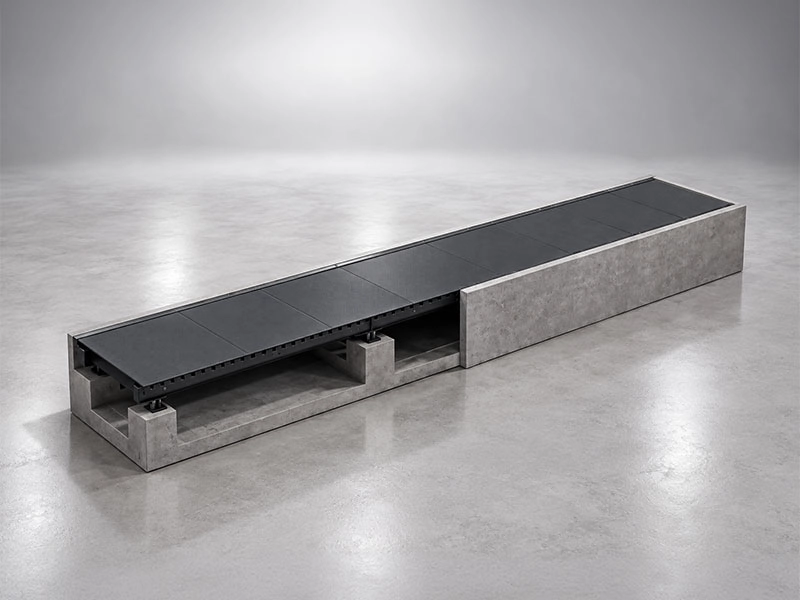
WB-X800P is a pit-type truck scale with an I-beam supported, full steel platform, mounted in a pit below ground level. As the platform stays at road level, it takes up no extra ground space and makes manoeuvring easier at factory entrances and on tight sites. This top-segment model of the WB-X range is built to work for many years in demanding heavy-duty settings such as mining, construction, the steel industry and agriculture and livestock.
The ramps at either end of a surface-mounted scale demand a considerable length on top of the platform itself. WB-X800P has no ramps: the platform sits in the pit and its top surface finishes level with the surrounding paving. The scale becomes a section of the internal road. A lorry drives straight on, is weighed, and leaves on the same plane to continue on its way.
This arrangement is decisive in particular situations. If the distance between the factory gate and the office or production hall is short, a ramped scale will not fit in that space. If vehicles must turn as soon as they leave the scale, a trailer coming down a ramp finds no room to turn. If the lane holding the scale is shared with forklifts, loaders or pedestrians, a raised platform becomes an obstacle. A pit installation solves all three at once.
Having the platform at road level also makes a difference to driving. With no ramp to climb, there is no throttle or braking load on the scale; horizontal forces fall, weighings settle sooner and the platform’s structure is strained less.
The platform’s backbone is built from rolled IPE I-sections. The I section gives high resistance to bending and takes heavy wheel loads down to the cells without inflating the platform’s own weight. The beams are covered with a top plate at least 10 mm thick; this lower limit is set so that the concentrated load from the wheel of a loaded mining truck or a full concrete mixer is spread without the surface sinking.
For a steel platform working in a pit, surface protection and ventilation matter as well. The underside never sees daylight and stays damp, so the corrosion protection of the paint system, the welds and the beam seats over each cell should be discussed before installation. On sites crossed by vehicles carrying fertiliser, salt or chemicals, this is settled at the quotation stage.
The compression load cells under the platform have a nominal capacity of 30 t, stainless steel bodies and IP68 protection; their accuracy class is OIML R60 C4. Standard mounting kits limit the side force a braking or angled vehicle applies to the platform and keep the measurement from drifting.
WB-X800P is built 3 m wide in nine lengths between 6 and 22 m. Capacity is kept low on short platforms and high on long ones, because platform length also limits the total weight of a vehicle that can stand on it:
With a pit-type scale, the length decision is even more permanent than with surface models; extending the platform means rebuilding the pit. So, besides today’s fleet, the longest combination that may reach the site in the coming years should be taken into account. For capacity, a reasonable margin is left above the heaviest loaded vehicle. For example, if trucks leaving a quarry approach 70 t when loaded, choosing 100 t rather than 80 t leaves a safe band for overloaded trips.
Divisions run from 20 to 50 kg and work together with the indicator’s dual-range weighing. Tare weighings of empty vehicles are read in the lower range with a fine step, loaded vehicles in the upper range with a step that suits the capacity.
Mining and quarries. Trucks carrying ore and aggregate are heavy and have short wheelbases, so they put their load on a small area of the platform. The I-beam structure and thick deck plate are chosen for that concentrated load. Having the scale at road level at the quarry exit also removes the problem of climbing a ramp on muddy tyres.
Construction and ready-mix concrete. Mixers, tippers and plant pass through the same entrance all day. A pit-type scale works within that traffic without cutting across the site or plant road.
Steel industry. In scrap buying and in billet and coil dispatch, both incoming and outgoing tonnage carry commercial consequences. For heavy, concentrated loads, a premium load-bearing structure helps measurement stay consistent over the long term.
Agriculture and livestock. At businesses that weigh vehicles carrying feed, silage, grain or livestock at the gate, a scale offering a level crossing to everything from a tractor with trailer to an articulated lorry makes daily work easier.
On the electronic side of the measuring chain sits an indicator whose analogue-to-digital stage is a 24-bit sigma-delta design. A 1/30000 conversion resolution and vibration-filtering software give a stable value despite the shaking of a heavy vehicle with its engine running. The indicator’s dual-range function allows a finer interval in the lower range for legal-for-trade weighing, and its 26 mm backlit LCD digits suit an operator reading from a distance. The weighbridge software archives weighings and turns them into reports in five file types (spreadsheet, XML, PDF, HTML and TXT), and an optional web database provides remote access. Once traffic lights and plate recognition are added, the queue at the factory entrance runs in a more orderly way.
The platform stays at road level and needs no room for ramps, so vehicles manoeuvre more easily at narrow factory gates.
Rolled I-section members carry heavy, concentrated wheel loads to the cells without making the platform excessively heavy.
The top plate is never thinner than 10 mm, preventing surface sinking under heavy trucks and mixers.
Designed for long service in demanding settings such as mining, construction, steel and agriculture-livestock.
Nine lengths and 4 to 10 cells provide options from a short tipper to a long drawbar combination.
Stainless, IP68-protected, C4-class 30 t cells and side-load kits come as standard.
| MODEL | DIMENSIONS (m.) | LOAD CELL (NUMBER) | CAPACITY (TON) | INSTALLMENT (Kg.) |
|---|---|---|---|---|
| TS-3-364 | 3X6 | 4 | 40 t | 10 / 20 kg |
| TS-3-384 | 3X8 | 4 | 40-50-60 t | 10 / 20 kg |
| TS-3 -3106 | 3X10 | 6 | 40-50-60 t | 10 / 20 kg |
| TS-3 -3126 | 3X12 | 6 | 40-50-60 t | 10 / 20 kg |
| TS-3 -3146 | 3X14 | 6 | 60-80 t | 20 kg - 50 kg |
| TS-3 -3168 | 3X16 | 8 | 60-80-100 t | 20 kg - 50 kg |
| TS-3 -3188 | 3X18 | 8 | 60-80-100 t | 20 kg - 50 kg |
| TS-3 -3208 | 3X20 | 10 | 60-80-100 t | 20 kg - 50 kg |
| TS-3 -3228 | 3X22 | 10 | 60-80-100 t | 20 kg - 50 kg |
 Vehicle Scale Applications
 Cargo
Cargo Transport
Both are installed in a pit and stay level with the ground. In the concrete model, the deck is C50 concrete inside a steel frame, and length stops at 20 m and capacity at 80 t. In the steel model, IPE I-beams do the carrying, with lengths reaching 22 m and capacity reaching 100 t. If you are after a premium structure, a platform longer than 20 m or more than 80 t, the choice is WB-X800P.
Any steel structure in contact with moisture and salt carries a corrosion risk; in a pit, that risk depends on keeping the underside dry. With good drainage, a suitable paint system and regular cleaning, a steel platform works trouble-free for many years. On sites handling aggressive loads, surface protection is specified separately at the quotation stage.
For short-wheelbase mining trucks, 10–14 m is often enough; but because loaded weights are high, 80 t at 14 m or 100 t at 16 m and above is usually preferred. The final decision is made once the loaded weight and length of the heaviest truck using the site are known.
As the platform is at road level, other site vehicles can cross it. Keeping tracked machines and vehicles above the scale’s capacity off the platform is important, however, for the life of the load cells and the deck plate.
The length, width and depth of the pit are designed around the chosen platform, the capacity and the ground survey. Drainage, steel edge sections at the pit mouth, the movement gap between platform and wall, maintenance access and the cable duct are all resolved together in the design.
The deck plate is the surface that spreads the load from the small area under a tyre onto the beams. Under heavy-duty conditions a thin plate gradually dishes inwards between the beams and the surface becomes wavy. The 10 mm minimum is there to prevent that kind of permanent deformation.
Quote requested forWB-X800P I-Beam Steel Pit Type Truck Scale
Still with you after installation
Send repair, maintenance and calibration requests through the Technical Service page or by phone.