














Steel Bar and Sheet Scale
- Capacity
- 1.5 t – 15 t
- Dimensions
- 120×120 – 150×600 cm
Bagging machines for grain, fertiliser, pellets, coal and powders. 5–50 kg bags, ±50–200 g accuracy. Let us help you choose the right model.

M-DF1Double Gate Bagging Machine
M-DB1Double Belt Bagging Machine
M-SF1Single Gate Bagging Machine
M-SB1Single Belt Bagging Machine
M-SF2Economical Single Gate Bagging Machine
M-AF1Auger Bagging Machine
M-DB2-2LTwo-Station Double Belt Bagging Machine ProBBF big bag filling machine for powders and granules: 500–2000 kg bags, 15–30 bags an hour, fed by gravity, belt or auger.
All Big Bag Filling Machines modelsWeigh-based liquid filling machine for jerrycans, tins, pails and drums: two-stage fast and slow filling, net or gross mode, Ex-proof option.
All Liquid Filling Machines modelsTruck scales for surface or pit installation, with steel-reinforced concrete, I-beam or V-beam steel decks. 6–22 m long, 40–100 t capacity.

WB-X800FI-Beam Steel Platform Truck Scale
WB-X600V-Beam Bridge Type Truck Scale
WB-X800PI-Beam Steel Pit Type Truck Scale
WB-X400PSteel-Reinforced Pit Type Truck Scale
WB-X400FSteel-Reinforced Concrete Truck ScaleCheckweighers that weigh every pack in motion and reject under- and overweight packs: CW, and MCW for compact lines. Rejection, reporting, retrofit.
All Checkweighers modelsHeavy-duty floor scales: CP, TP, U-type pallet scale, MB modular, steel bar and marble scales. Four OIML R60 C4 load cells, sized to the load.
All Heavy Duty Scales modelsBS single load cell platform scale: 30 kg–1.5 t, double-chassis electronic construction and dual-range weighing for bench and packing use.
All Bench Scales modelsMonorail scales for abattoirs and meat plants: carcasses are weighed on the rail. Fitted to your existing line, stainless or galvanised.
All Monorail Scales modelsLivestock scales for cattle, sheep, goats and sacrifice shares: the 80 mm low-profile BBH, gated KBH and a 7-point share scale.
All Livestock Scales modelsBK belt weigher for weighing bulk material on the conveyor without stopping the line: 800–2000 mm belts, flows up to 6000 t/h.
All Belt Weighers modelsFarms, feedlots and grain businesses.
Weighbridge yards, warehouses and dispatch.
Packing, filling and end-of-line checking.
Bulk material and vehicle weighing.
Liquid and powder filling.
Vehicle and platform weighing.
Surface and pit-mounted weighbridges for trucks and tractors.
Cattle and small livestock; low platforms for the farm.
Floor scales, pallet scales and single-cell platform scales.
Continuous flow and totalised weight on the belt.
Bag, big bag and liquid filling; automatic weighing lines.
Weighs packed products in line and rejects under- and overweight.
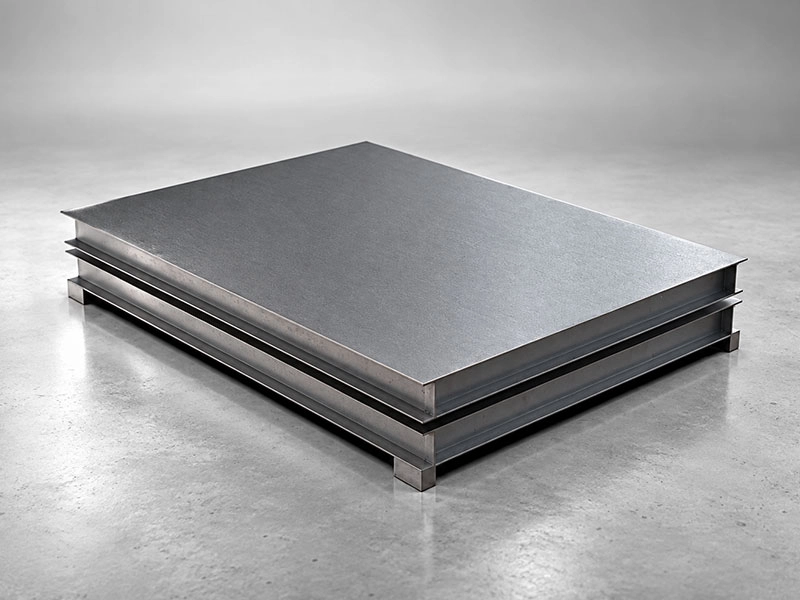
The CP platform floor scale is a floor scale with a double-chassis steel frame, designed to weigh pallets, crates and heavy parts set down by forklift over and over again every day. Each corner carries an IP68-protected OIML R60 C4 load cell, and dual-range weighing gives a capacity ladder from 600 kg up to 10 tonnes. It suits fixed weighing stations in production, storage, dispatch and quality control that are expected to stand up to heavy traffic.
To weigh correctly, a floor scale platform must pass the weight to its four cells without bending, wherever the load is placed. On the CP this job falls to a steel chassis working in two layers, one above the other. The upper layer carries the weighing surface, while the lower layer channels the force to the corner cells. This arrangement limits platform flex, which would otherwise shift the reading when a pallet lands near an edge instead of dead centre.
The second benefit of the double chassis is durability. Forks scraping the deck, loads dropped from a few centimetres up, or hundreds of pallets landing on the same spot all day will eventually leave dents and ripples in thin plate. The CP frame is dimensioned for this repeated punishment and is specified as resistant to overloading. The surface is finished with electrostatic oven-baked paint, which protects the steel against moisture and abrasion in warehouse and production settings.
The four load cells under the platform are rated IP68. This rating means the cell is fully protected against dust and sealed to withstand prolonged exposure to water. In a production area whose floor is washed often, or at a loading door where meltwater is tracked in during winter, cell protection directly decides how long the scale lasts.
The four general-purpose models in the heavy-duty group do the same job for different ways of loading. The most decisive question in choosing between them is how the load reaches the scale:
In terms of capacity and platform size, the CP and TP are built across the same range. The real difference between them lies in the frame and the loading method: the CP, with its stiff double chassis, is designed around forklift impact, while the TP, with its low single-piece deck, is designed for wheeled traffic.
Capacities in the CP technical table are given as two figures, for example 1500/3000 kg × 0.5/1 kg. This means dual-range weighing: for loads up to 1,500 kg the indicator reads in 0.5 kg steps, and between 1,500 kg and 3,000 kg in 1 kg steps. Light crates can therefore be weighed with a fine step and full pallets at full capacity on the same scale.
A practical approach is to match the heaviest load to the upper range and the most frequent load to the lower range. For example, if you mostly weigh pallets of 400–900 kg and occasionally a 2,200 kg machine part comes through, the 1500/3000 kg model covers both needs. If every daily pallet is under 600 kg and heavy parts never appear, the finer step of the 600/1000 kg model makes more sense.
Platform size grows with capacity. The smallest size is 100 × 100 cm and the largest 200 × 300 cm, while the 6000/10000 kg range comes with platforms from 150 × 150 cm upwards. When the listed sizes are not enough, the CP can also be built to the size and capacity you need. All we need for that is the length, width and weight of the largest load you will weigh.
The CP is installed as a fixed weighing station. With heavy forklift traffic, setting the platform into a pit lets the driver put the load down as if moving over level floor. In rented premises, or on a line that may move later, a surface installation with a ramp added alongside is more flexible. Whichever is chosen, the floor under all four cells must be at one level and the platform edges must not touch any surrounding surface.
In daily work the indicator functions save time. Power-on zero tracking starts the scale from zero each morning; manual tare entry lets you store the weight of a pallet type once and deduct it all day. In checkweighing mode lower and upper limits are set; when the load falls below, within or above the band, the indicator shows HI, OK or LO and sounds a buzzer. For dispatch, the RS 232 output is used to print tickets or labels and pass records to a computer.
The two-layer steel chassis limits platform flex even with off-centre loads and strengthens the frame against forklift impact.
The OIML R60 C4 cells at the four corners are sealed against dust and water, so they work reliably in washed and damp areas too.
It reads in a fine step in the lower part of the capacity and a wider step in the upper part, weighing light and heavy loads on one scale.
It shows HI, OK and LO against the limits you set, with a buzzer, so an under- or over-loaded pallet is spotted at once.
Through its RS 232 output it sends tickets and labels to a printer and passes weighing records to a computer.
The indicator runs on its built-in rechargeable battery or on 220 V mains; auto power-off stops the battery draining needlessly.
| MODEL | CAPACITY | DIMENSIONS (cm) |
|---|---|---|
| CP+4LC | 300 / 600 kg x 0.1/0.2 Kg | 100X100,120×120 |
| CP+4LC | 600 / 1000 kg x 0.2/0.5 Kg | 100X100,120×120,120X150 |
| CP+4LC | 600 / 1500 kg x 0.2/0.5 Kg | 120×120,120X150,150X150 |
| CP+4LC | 1500 / 3000 kg x 0.5/1 Kg | 120×120,120X150,150X150 |
| CP+4LC | 3000 / 6000 kg x 1/2 Kg | 120X150,150X150,150X200,200X200 |
| CP+4LC | 6000 / 10000 kg x 2/5 Kg | 150X150,150X200,200X200,200X300 |
 Production
 Storage
 Cargo
Cargo Transport
 Quality Control
 Commercial Weighing Applications
Choose the CP if a forklift sets the load down and the weighing point will never move; its double-chassis frame is designed for impact and intensive use. If the load is wheeled on by pallet truck and you do not want a pit in the floor, the low TP with ramps on both sides is the better fit.
The scale then has to be chosen for the forklift’s own weight plus the load it carries. If you plan this kind of use, tell us the forklift weight at the quotation stage and the capacity and platform size will be set accordingly. On most sites the forklift only sets the load down and never goes onto the platform.
It reads in 0.5 kg steps up to 1,500 kg and in 1 kg steps above 1,500 kg up to 3,000 kg. The same logic applies to the other models; on the 300/600 kg model, for instance, the steps are 0.1 and 0.2 kg.
The size is decided by your largest pallet and how easily the forklift driver can place it. A 1,200 × 1,000 mm pallet fits a 120 × 120 cm platform but leaves no margin at the edges; the driver must set it exactly in the middle every time. On a 150 × 150 cm platform the same pallet is far easier to position.
Yes. The indicator can switch between kilograms, pounds and litres. Once a unit weight is entered it can count pieces, for example to work out how many cartons of one type a pallet holds.
Yes, the CP can also be built to the size and capacity you require. Telling us the load dimensions, its heaviest weight and how it will be loaded lets us specify a suitable frame and cell set.
Quote requested forCP Floor Scale
Still with you after installation
Send repair, maintenance and calibration requests through the Technical Service page or by phone.