














WB-X800F I-Beam Steel Platform Truck Scale
- Capacity
- 40 t – 100 t
- Dimensions
- 3×6 – 3×22 m
Bagging machines for grain, fertiliser, pellets, coal and powders. 5–50 kg bags, ±50–200 g accuracy. Let us help you choose the right model.

M-DF1Double Gate Bagging Machine
M-DB1Double Belt Bagging Machine
M-SF1Single Gate Bagging Machine
M-SB1Single Belt Bagging Machine
M-SF2Economical Single Gate Bagging Machine
M-AF1Auger Bagging Machine
M-DB2-2LTwo-Station Double Belt Bagging Machine ProBBF big bag filling machine for powders and granules: 500–2000 kg bags, 15–30 bags an hour, fed by gravity, belt or auger.
All Big Bag Filling Machines modelsWeigh-based liquid filling machine for jerrycans, tins, pails and drums: two-stage fast and slow filling, net or gross mode, Ex-proof option.
All Liquid Filling Machines modelsTruck scales for surface or pit installation, with steel-reinforced concrete, I-beam or V-beam steel decks. 6–22 m long, 40–100 t capacity.

WB-X800FI-Beam Steel Platform Truck Scale
WB-X600V-Beam Bridge Type Truck Scale
WB-X800PI-Beam Steel Pit Type Truck Scale
WB-X400PSteel-Reinforced Pit Type Truck Scale
WB-X400FSteel-Reinforced Concrete Truck ScaleCheckweighers that weigh every pack in motion and reject under- and overweight packs: CW, and MCW for compact lines. Rejection, reporting, retrofit.
All Checkweighers modelsHeavy-duty floor scales: CP, TP, U-type pallet scale, MB modular, steel bar and marble scales. Four OIML R60 C4 load cells, sized to the load.
All Heavy Duty Scales modelsBS single load cell platform scale: 30 kg–1.5 t, double-chassis electronic construction and dual-range weighing for bench and packing use.
All Bench Scales modelsMonorail scales for abattoirs and meat plants: carcasses are weighed on the rail. Fitted to your existing line, stainless or galvanised.
All Monorail Scales modelsLivestock scales for cattle, sheep, goats and sacrifice shares: the 80 mm low-profile BBH, gated KBH and a 7-point share scale.
All Livestock Scales modelsBK belt weigher for weighing bulk material on the conveyor without stopping the line: 800–2000 mm belts, flows up to 6000 t/h.
All Belt Weighers modelsFarms, feedlots and grain businesses.
Weighbridge yards, warehouses and dispatch.
Packing, filling and end-of-line checking.
Bulk material and vehicle weighing.
Liquid and powder filling.
Vehicle and platform weighing.
Surface and pit-mounted weighbridges for trucks and tractors.
Cattle and small livestock; low platforms for the farm.
Floor scales, pallet scales and single-cell platform scales.
Continuous flow and totalised weight on the belt.
Bag, big bag and liquid filling; automatic weighing lines.
Weighs packed products in line and rejects under- and overweight.
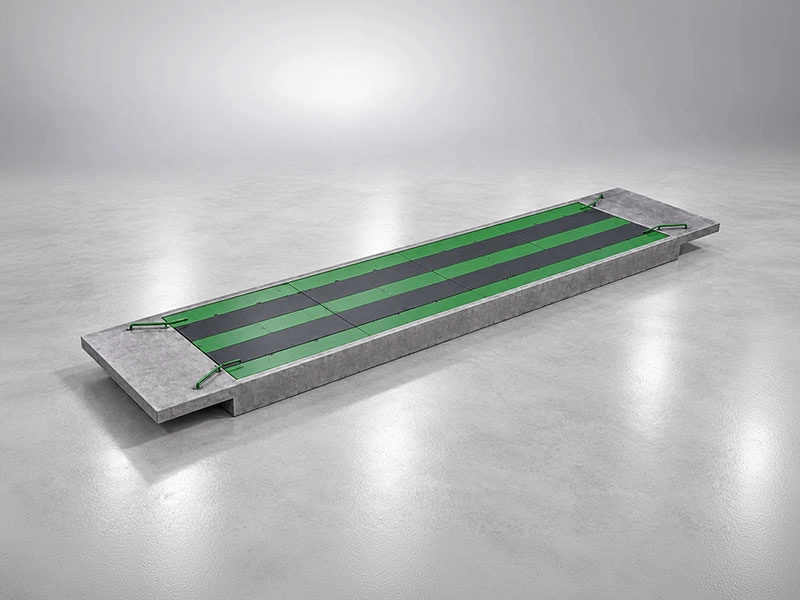
WB-X400P is a pit-type concrete truck scale installed in a pit so that its platform finishes level with the surrounding ground. The deck is made by filling pre-stressed reinforcement inside a steel frame with C50 concrete, and vehicles roll across it just as they would along any paved lane. Positioned in the mid segment of the WB-X range, this model is designed for factory entrances that cannot spare space for ramps and for sites with tight manoeuvring room.
The P in the model name refers to pit installation. X400 indicates a concrete deck and places the scale in the standard segment of the range. The same deck is used in the surface-mounted WB-X400F; the one essential difference between the two is the height at which each scale is set. For a business considering WB-X400P, the real question therefore comes before “concrete or steel”: it is “ramps or a pit”.
In a pit installation the platform surface ends at the same level as the surrounding paving. Vehicles neither climb nor descend; the driver approaches the scale as if entering an ordinary stretch of road. As a result there is no needless braking on the platform, horizontal force during weighing drops, and the indicator settles on a stable value more easily.
WB-X400P is chosen most often by businesses whose scale will sit on the main entrance road of the site. The gate of a factory receiving raw materials usually opens onto a public road, leaving no spare distance between gate and building for the length of a ramp. At haulage and cargo yards, vehicles have to pull up both at the scale and at the loading docks; a scale at road level simplifies that manoeuvre. Where forklifts, loaders or pedestrians cross the same point as the lorries, a flat crossing surface improves both safety and flow.
The platform is derived from the pre-stressed construction used in road bridges. Tensioned reinforcement is placed in a casing formed by the steel frame, and the void is filled with high-strength C50 concrete. The steel frame protects the edges and gives the deck its shape; the concrete adds mass and compressive strength.
In a pit, this construction brings two separate benefits. First, the heavy deck sits steadily in the pit, and the oscillation set up by a lorry crossing the scale dies away quickly. Second, a concrete surface in contact with rainwater, mud and salt does not wear as fast as bare steel plate; only the frame edges and connection points need watching for corrosion. Where the scale sits on a main internal road also crossed by forklifts and loaders, that durability matters even more.
The load-bearing deck stands on compression load cells of 30 t each. The cells are made of stainless steel, sealed to IP68 against water and dust, and belong to accuracy class OIML R60 C4. As the pit is the installation type where moisture is felt most, this protection is particularly valuable here. Standard mounting hardware restricts sideways movement of the platform so that the push of an entering vehicle does not upset the reading.
The success of a pit-type scale depends largely on a well-designed pit. For WB-X400P, pit dimensions are worked out from the chosen platform length, the capacity and the ground survey. These are the main points to settle at the design stage:
Removing ramp construction reduces the total site area needed, but it does not remove civil work; excavation, pit concrete and a drainage line mean more building than a surface installation. That difference should be weighed against the space gained and the smoother traffic flow.
WB-X400P is 3 m wide, with a choice of five lengths: 8, 12, 14, 16 or 20 m. The number of cells carrying the platform rises with length: 6 at 8 m, 8 at 12 m, 10 at 14 and 16 m, and 12 at 20 m. Capacity is in the 60–80 t range for every size, and the scale interval works in two ranges of 20/50 kg.
In practice, dual-range division means the indicator reads in 20 kg steps while the load is in the lower range and in 50 kg steps once it passes into the upper range. For example, the tare weighing of an empty tractor unit is taken in fine steps, while a loaded articulated lorry is weighed in coarser steps that suit the capacity. A single scale thus gives meaningful results on both empty returns and loaded arrivals.
When choosing length, remember that extending a pit installation later in practice means building a new pit. If a plant that works with rigid trucks today plans to receive articulated lorries within a few years, choosing 16 m or more from the start is the more economical route.
The weighing indicator works with a 24-bit sigma-delta converter and has an internal resolution of 1/30000. Its vibration filter suppresses the fluctuation produced by a lorry waiting with its engine running. The 26 mm digits on the backlit LCD are easy to read from the weighbridge office, and the dual-range function delivers finer results in the lower range for legal-for-trade weighing.
The weighbridge software keeps weighings in a database and can export them to XML, PDF, HTML, TXT and spreadsheet files. Traffic lights and a plate recognition camera can be connected to the software, and an optional web database gives access to records from outside the site. Considering that a pit-type scale usually sits at the plant entrance in the middle of heavy traffic, a light-controlled flow that recognises plates on its own shortens queues noticeably.
The platform finishes flush with the road surface; vehicles enter without climbing a ramp and manoeuvring at narrow gates becomes easier.
Ramp construction and the length set aside for ramps disappear; the scale simply becomes a section of the internal road.
A concrete deck strengthened by a steel frame and tensioned reinforcement keeps its stiffness under impact and constant heavy traffic.
Stainless-bodied, IP68-sealed, class OIML R60 C4 cells of 30 t stand up well to moisture in the pit.
Light and empty vehicles are weighed in fine steps, loaded lorries in steps that match the capacity.
Because the deck is not cast into the pit, it can be lifted out and taken to another area when needed.
| MODEL | DIMENSIONS (m.) | LOAD CELL (NUMBER) | CAPACITY (TON) | INSTALLMENT (Kg.) |
|---|---|---|---|---|
| TS-5C-386 | 3×8 | 6 | 60-80 t | 10 / 20 kg |
| TS-5C-3128 | 3×12 | 8 | 60-80 t | 10 / 20 kg |
| TS-5C-31610 | 3×16 | 10 | 60-80 t | 10 / 20 kg |
| TS-5C-32012 | 3×20 | 12 | 60-80 t | 10 / 20 kg |
 Vehicle Scale Applications
 Cargo
Cargo Transport
Yes. With no ramps, WB-X400P can be entered and left from either end. Setting up a one-way traffic pattern is still advisable, so that vehicles do not reverse on the scale and the queue moves in an orderly way.
The platform can; the deck is neither buried nor cast into the pit, so it can be lifted by crane and taken to a new area. The pit itself stays where it is, and a new pit of the same dimensions has to be built at the new location. If relocation is likely, the surface-mounted WB-X400F is the more flexible option.
Both are installed flush with the ground. WB-X400P is the standard-segment model with a concrete deck, offered from 8 to 20 m and 60 to 80 t. WB-X800P is the top-segment model with an I-beam, full steel platform, available from 6 to 22 m with capacities up to 100 t. If you need a very long platform or more than 80 t, WB-X800P is the answer; if the mass and surface durability of a concrete deck come first, WB-X400P stands out.
The aim is not to stop it but to remove it. The base of the pit is sloped so that water gathers in a sump and is sent to a drainage line or an automatic pump. The approach roads are also graded so that rainwater runs away from the scale.
The scale weighs correctly as long as the deck can move freely on its load cells. If stones, mud or ice jam the gap, the deck leans against the wall and part of the load passes into the wall instead of the cells; the result is an under-reading. That is why the gap should be checked and cleaned regularly.
If water left in the pit freezes, ice forms around the cells and the movement gap can close. Checking the drainage before winter and confirming each morning that an empty deck reads zero are the simplest ways to spot such errors early.
Quote requested forWB-X400P Steel-Reinforced Pit Type Truck Scale
Still with you after installation
Send repair, maintenance and calibration requests through the Technical Service page or by phone.