Bagging machines for grain, fertiliser, pellets, coal and powders. 5–50 kg bags, ±50–200 g accuracy. Let us help you choose the right model.

M-DF1Double Gate Bagging Machine

M-DB1Double Belt Bagging Machine

M-SF1Single Gate Bagging Machine

M-SB1Single Belt Bagging Machine

M-SF2Economical Single Gate Bagging Machine

M-AF1Auger Bagging Machine

M-DB2-2LTwo-Station Double Belt Bagging Machine ProBBF big bag filling machine for powders and granules: 500–2000 kg bags, 15–30 bags an hour, fed by gravity, belt or auger.
All Big Bag Filling Machines modelsWeigh-based liquid filling machine for jerrycans, tins, pails and drums: two-stage fast and slow filling, net or gross mode, Ex-proof option.
All Liquid Filling Machines modelsTruck scales for surface or pit installation, with steel-reinforced concrete, I-beam or V-beam steel decks. 6–22 m long, 40–100 t capacity.

WB-X800FI-Beam Steel Platform Truck Scale

WB-X600V-Beam Bridge Type Truck Scale

WB-X800PI-Beam Steel Pit Type Truck Scale

WB-X400PSteel-Reinforced Pit Type Truck Scale

WB-X400FSteel-Reinforced Concrete Truck ScaleCheckweighers that weigh every pack in motion and reject under- and overweight packs: CW, and MCW for compact lines. Rejection, reporting, retrofit.
All Checkweighers modelsHeavy-duty floor scales: CP, TP, U-type pallet scale, MB modular, steel bar and marble scales. Four OIML R60 C4 load cells, sized to the load.
All Heavy Duty Scales modelsBS single load cell platform scale: 30 kg–1.5 t, double-chassis electronic construction and dual-range weighing for bench and packing use.
All Bench Scales modelsMonorail scales for abattoirs and meat plants: carcasses are weighed on the rail. Fitted to your existing line, stainless or galvanised.
All Monorail Scales modelsLivestock scales for cattle, sheep, goats and sacrifice shares: the 80 mm low-profile BBH, gated KBH and a 7-point share scale.
All Livestock Scales modelsBK belt weigher for weighing bulk material on the conveyor without stopping the line: 800–2000 mm belts, flows up to 6000 t/h.
All Belt Weighers modelsFarms, feedlots and grain businesses.
Weighbridge yards, warehouses and dispatch.
Packing, filling and end-of-line checking.
Bulk material and vehicle weighing.
Liquid and powder filling.
Vehicle and platform weighing.
Surface and pit-mounted weighbridges for trucks and tractors.
Cattle and small livestock; low platforms for the farm.
Floor scales, pallet scales and single-cell platform scales.
Continuous flow and totalised weight on the belt.
Bag, big bag and liquid filling; automatic weighing lines.
Weighs packed products in line and rejects under- and overweight.

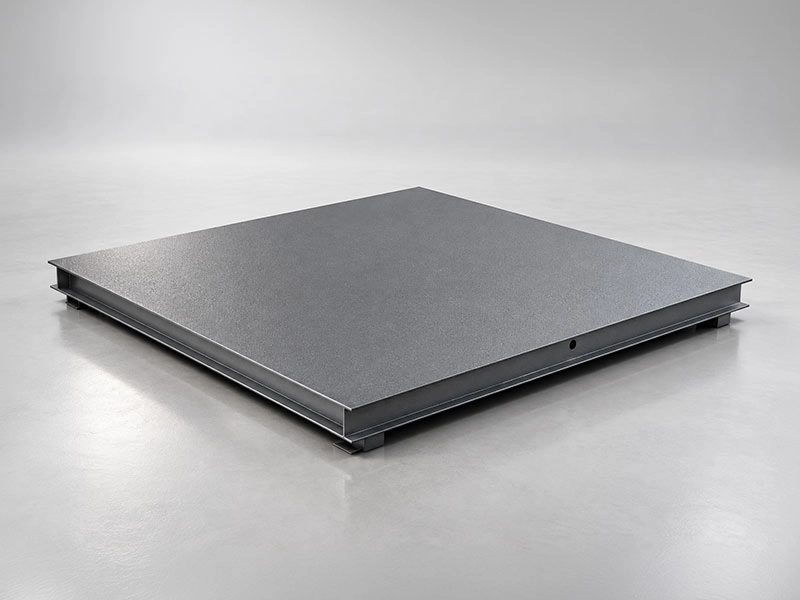
The TP floor scale has a single-piece steel deck on which pallet trucks and wheeled trolleys are weighed by going up one ramp and down the opposite one. Because the platform stands only about 10 cm off the floor, no pit is needed; underneath it work four IP68-protected OIML R60 C4 load cells. It is designed for warehouses that move pallets on hand-pushed pallet trucks, for parcel sorting areas and for material flow inside production.
The whole TP design is built around a single movement: the operator pushes the loaded pallet truck up the ramp, stops on the platform, reads the value and carries on down the ramp on the far side. The pallet is not taken off the truck, nobody waits for a forklift and nobody lifts the load. This flow brings a clear time saving, especially at dispatch doors where dozens of pallets are weighed in a single day.
Keeping the platform height to about 10 cm is the detail that makes this movement possible. As height increases, the ramp either gets longer or steeper; pushing a heavy pallet up a steep ramp is hard work, and on the way down the load has to be held back. As a simple calculation, climbing 10 cm over a 1-metre ramp means a gradient of roughly 10 per cent. Ramp size is assessed together with the approach space on site and the weight of the loads being moved.
Because the deck is made from one piece of steel, the surface the wheels roll over has no joints, steps or gaps. Narrow pallet truck wheels move across without catching, and there are no awkward corners that are hard to clean. The frame is resistant to overloading and finished with electrostatic oven-baked paint.
Within the heavy-duty group, the TP is the model dedicated to wheeled traffic. Since the CP is built in the same capacities and platform sizes, it helps to be clear where the two part ways:
Pallets can also be set down on the TP by forklift, but if the forklift is the main workhorse on site, the double-chassis CP is the more suitable starting point. Where the TP really shines is in hand-pushed traffic that flows without a break from ramp to ramp.
When the reading is taken with the pallet truck on the platform, the value shown is the pallet, the goods and the truck together. For a correct net weight, the truck’s weight is deducted as tare. There are two ways to do this: run the empty truck onto the platform and take a tare, or key the truck’s known weight into the indicator by hand. The second method removes the need to weigh the empty truck each time in areas where the same truck is used all day.
For example, if the indicator reads 1,142 kg, the truck weighs 78 kg and the empty pallet 24 kg, the net weight of the goods is 1,040 kg. In warehouses where two trucks of different weights share one scale, operators must be clear which truck goes with which tare value; otherwise a systematic error of a few kilograms can creep into the records.
The TP is built in dual-range capacities from 300/600 kg to 6000/10000 kg. The two-figure notation means the lower part of the range reads in a finer step and the upper part in a coarser one; the 600/1500 kg model, for instance, reads in 0.2 kg steps up to 600 kg and in 0.5 kg steps above. Most pallets moved by pallet truck fall within the range of this model or the 1500/3000 kg model.
Platform sizes run from 100 × 100 cm to 200 × 300 cm. With pallet trucks, choosing the size means the full length of the truck has to fit on the platform, not just the pallet: at the moment of weighing, the front rollers and the steering wheel of the truck must all be on the deck, none left on a ramp. For wheeled traffic, therefore, platform length is worked out from the truck’s wheelbase rather than the long side of the pallet. If the listed sizes do not meet the need, a TP with custom dimensions and capacity can be ordered.
The layout should leave a straight, level approach area in front of each ramp where the truck can line up. If the operator enters the ramp at an angle, a wheel loads the edge of the platform and the reading takes longer to settle. Placing the indicator at a height and angle the operator can see without letting go of the truck also speeds up the flow.
A one-piece steel surface with no joints lets pallet truck wheels roll across without catching and makes cleaning easier.
The low deck and ramps on each side let the truck go up one side and down the other, with no pit in the floor.
The four OIML R60 C4 cells under the platform are sealed against water and dust for floor washing and damp conditions.
Truck and pallet weights can be keyed in or tared on the platform, so the display shows the net goods weight directly.
The lower range uses a fine step and the upper range a wider one, so single cartons and full pallets share one platform.
The RS 232 connection prints tickets and labels and transfers weighing records to a computer.
| MODEL | CAPACITY | DIMENSIONS (cm) |
|---|---|---|
| TP+4LC | 300/600 kg x 0.1/0.2 Kg | 100X100,120×120 |
| TP+4LC | 600/1000 kg x 0.2/0.5 Kg | 100X100,120×120,120X150 |
| TP+4LC | 600/1500 kg x 0.2/0.5 Kg | 120×120,120X150,150X150 |
| TP+4LC | 1500/3000 kg x 0.5/1 Kg | 120×120,120X150,150X150 |
| TP+4LC | 3000/6000 kg x 1/2 Kg | 120X150,150X150,150X200,200X200 |
| TP+4LC | 6000/10000 kg x 2/5 Kg | 150X150,150X200,200X200,200X300 |
Production
Storage
Cargo
Transport
Quality Control
Commercial Weighing ApplicationsNo. The TP is installed on the floor surface and its deck, about 10 cm high, is reached by the ramps on either side. A level, solid floor is all it needs. If you want the platform flush with the floor, the CP, which is suitable for pit installation, is considered instead.
Yes, provided every wheel of the truck is on the platform and none touches a ramp. Since the reading includes the truck, its weight is deducted as tare or keyed into the indicator in advance.
Ramp length depends on the weight being pushed and the approach space on site. A longer ramp gives a gentler gradient but takes up more room. Just tell us your heaviest pallet and the space you can set aside for the ramps.
Electric pallet trucks are noticeably heavier than hand-pushed ones because of their battery. Since the vehicle itself stands on the platform during weighing, capacity must be chosen for the vehicle weight plus the load it carries. Mention the truck type at the quotation stage.
Yes. Because the lower range of dual-range weighing uses a fine step, individual cartons are weighed with meaningful precision too. On the 600/1500 kg model, for example, a 0.2 kg step applies up to 600 kg.
In the indicator’s checkweighing function you set a lower and upper limit. If a pallet falls outside that band the display shows LO or HI, within it OK, and a buzzer sounds; the operator notices before the pallet leaves the ramp.
Quote requested forTP Floor Scale
Still with you after installation
Send repair, maintenance and calibration requests through the Technical Service page or by phone.