Bagging machines for grain, fertiliser, pellets, coal and powders. 5–50 kg bags, ±50–200 g accuracy. Let us help you choose the right model.

M-DF1Double Gate Bagging Machine

M-DB1Double Belt Bagging Machine

M-SF1Single Gate Bagging Machine

M-SB1Single Belt Bagging Machine

M-SF2Economical Single Gate Bagging Machine

M-AF1Auger Bagging Machine

M-DB2-2LTwo-Station Double Belt Bagging Machine ProBBF big bag filling machine for powders and granules: 500–2000 kg bags, 15–30 bags an hour, fed by gravity, belt or auger.
All Big Bag Filling Machines modelsWeigh-based liquid filling machine for jerrycans, tins, pails and drums: two-stage fast and slow filling, net or gross mode, Ex-proof option.
All Liquid Filling Machines modelsTruck scales for surface or pit installation, with steel-reinforced concrete, I-beam or V-beam steel decks. 6–22 m long, 40–100 t capacity.

WB-X800FI-Beam Steel Platform Truck Scale

WB-X600V-Beam Bridge Type Truck Scale

WB-X800PI-Beam Steel Pit Type Truck Scale

WB-X400PSteel-Reinforced Pit Type Truck Scale

WB-X400FSteel-Reinforced Concrete Truck ScaleCheckweighers that weigh every pack in motion and reject under- and overweight packs: CW, and MCW for compact lines. Rejection, reporting, retrofit.
All Checkweighers modelsHeavy-duty floor scales: CP, TP, U-type pallet scale, MB modular, steel bar and marble scales. Four OIML R60 C4 load cells, sized to the load.
All Heavy Duty Scales modelsBS single load cell platform scale: 30 kg–1.5 t, double-chassis electronic construction and dual-range weighing for bench and packing use.
All Bench Scales modelsMonorail scales for abattoirs and meat plants: carcasses are weighed on the rail. Fitted to your existing line, stainless or galvanised.
All Monorail Scales modelsLivestock scales for cattle, sheep, goats and sacrifice shares: the 80 mm low-profile BBH, gated KBH and a 7-point share scale.
All Livestock Scales modelsBK belt weigher for weighing bulk material on the conveyor without stopping the line: 800–2000 mm belts, flows up to 6000 t/h.
All Belt Weighers modelsFarms, feedlots and grain businesses.
Weighbridge yards, warehouses and dispatch.
Packing, filling and end-of-line checking.
Bulk material and vehicle weighing.
Liquid and powder filling.
Vehicle and platform weighing.
Surface and pit-mounted weighbridges for trucks and tractors.
Cattle and small livestock; low platforms for the farm.
Floor scales, pallet scales and single-cell platform scales.
Continuous flow and totalised weight on the belt.
Bag, big bag and liquid filling; automatic weighing lines.
Weighs packed products in line and rejects under- and overweight.

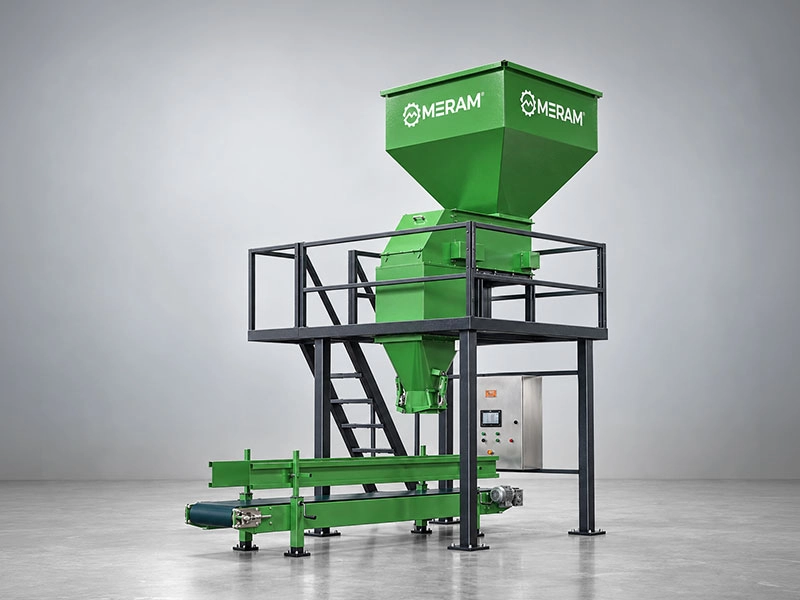
The M-SB1 single-belt bagging machine carries coarse, irregular or easily crumbling products such as wood pellets, feed pellets, coal and pumice to the weigh hopper on a feed belt and fills them into 25–50 kg bags. It runs at 250–400 bags per hour with ±50–150 g accuracy. It is the entry model of the belt range, aimed at medium-sized pellet producers, coal dealers and pumice quarries whose products jam or break in a gate machine.
In a gate machine, product pours freely through a flap that opens and closes. With small, round grains such as cereals this is no problem. A large lump of coal, however, can catch in the gate opening and stop it closing; pellets get trapped against the edge of the closing gate and break. The dust and fines this creates spoil the look of the bag and turn into quality complaints from pellet buyers.
On the M-SB1, product drops from the hopper onto a belt that carries it to the weigh hopper. Flow is set by belt speed rather than by the size of a gate opening. At the start of filling the belt runs fast, it slows as the target weight approaches, and the last grams are completed with a slow stream. With no sharp edge cutting through the product, breakage falls, and large pieces travel along the belt without jamming.
Pellets: with wood and feed pellets the main loss is breakage. Belt feeding reduces it, but the height from which pellets fall into the hopper matters too. Keeping that drop short at the hopper inlet completes the benefit the machine provides.
Coal: with coal of mixed piece size, large lumps and fines can separate on the belt. Keeping the hopper steadily full helps the belt deliver a similar mix to every bag. Because of coal dust, dust extraction around the filling spout should be considered.
Pumice: pumice is light and abrasive. Being light, 25 kg of pumice takes up far more volume than 25 kg of grain, so bag size and spout are chosen accordingly. Because it is abrasive, the belt surface and scrapers should be checked more often.
The table gives 250–400 bags per hour and two capacity ranges, 8–10 t/h and 9–10 t/h. The number of bags changes inversely with bag weight: light bags approach the upper end, heavy bags the lower end. For example, 400 bags of 25 kg an hour make 10 tonnes. When planning, the soundest approach is to look at a few shifts of real data after commissioning, so that the density and flow of your own product are taken into account.
A simple shift calculation: if 7.5 of 8 hours are net running time and 250 bags of 50 kg are filled per hour, the day ends with 1,875 bags, or about 94 tonnes of coal or pellets.
The belt motor and control system call for a three-phase mains connection (400 VAC, 50–60 Hz) on site. The bag holder and filling mechanism are pneumatic: the air line must deliver 8–10 bar, and the table bases this on a 300-litre compressor. The top hopper holds 1800 litres, and this volume can be changed to suit. The machine is placed under a silo or at the outlet of an elevator or conveyor that brings the product. On a pellet line the machine is often fed from the cooler and screen outlet; the hourly flow coming off the screen should then be assessed together with the machine’s capacity. At coal yards, an intermediate hopper above the machine filled by loader is a common arrangement.
On a belt machine, maintenance centres on the belt. Belt tension and tracking should be checked weekly and product stuck to the belt cleaned off. A slack belt slips when it speeds up, and the approach to the target weight becomes erratic. At the end of the shift, fines and dust inside the weigh hopper should also be removed; any build-up in the hopper is added to the weighing.
Coarse and fine filling come from the belt speeding up and slowing down; no gate cuts through the product.
Carries coarse, angular and fragile products to the weigh hopper without jamming or crumbling them.
A suitable pace for medium-sized pellet and coal lines; works with bags from 25 to 50 kg.
Approaches the target weight under control even with irregular products.
Buffers short gaps in the flow on lines fed by an elevator or conveyor.
Target weight and calibration are done on the screen; changing bag weight needs no mechanical work.
| Product type | Pellets, coal, etc. |
| Maximum weighing weight | Variable |
| Weighing range options | 25 – 50 Kg |
| Weighing accuracy | ± 50 – 150 gr |
| Upper hopper capacity | 1800 litres (Variable) |
| Weighing system | LoadSync™ TouchCommand™ Display |
| Output capacity | 8 – 10 / 9 – 10 t/h |
| Bagging rate | 400 – 250 bags / hour |
| System pressure | (300lt. compressor) 8-10 Bar |
| Power supply (VAC) | (±%5-10%) 400 VAC / 50-60Hz |
| Weight | 1.700 Kg |
Food and Chemical ProductionBreakage depends on the hardness and moisture of the pellets and the drop height, so we do not quote a fixed figure. Belt feeding removes the squeezing at a gate edge and so reduces the share of breakage caused by the machine.
Yes, belt feeding is the preferred choice for large, irregular pieces. Very large lumps can bridge at the hopper outlet, so please state the largest piece size of your coal at the quotation stage.
Because pumice is light, the same weight takes up far more volume. The bag length and mouth width must suit that volume, and this also decides the choice of spout.
Replacement intervals depend on how abrasive the product is and on running hours. With pumice and coal the belt surface wears faster than with grain; regular checks of tension and surface extend its life.
Then the double-belt M-DB1 or the two-station M-DB2-2L is considered. Which one suits you depends on your daily target and on how many operators you can put at the filling point.
Technically yes, but the hopper, belt and weigh hopper must be cleaned at each changeover. Coal dust in pellets is unacceptable, so businesses that change product often should build this cleaning time into their planning.
Quote requested forM-SB1 / Single Belt Bagging Machine
Still with you after installation
Send repair, maintenance and calibration requests through the Technical Service page or by phone.