Bagging machines for grain, fertiliser, pellets, coal and powders. 5–50 kg bags, ±50–200 g accuracy. Let us help you choose the right model.

M-DF1Double Gate Bagging Machine

M-DB1Double Belt Bagging Machine

M-SF1Single Gate Bagging Machine

M-SB1Single Belt Bagging Machine

M-SF2Economical Single Gate Bagging Machine

M-AF1Auger Bagging Machine

M-DB2-2LTwo-Station Double Belt Bagging Machine ProBBF big bag filling machine for powders and granules: 500–2000 kg bags, 15–30 bags an hour, fed by gravity, belt or auger.
All Big Bag Filling Machines modelsWeigh-based liquid filling machine for jerrycans, tins, pails and drums: two-stage fast and slow filling, net or gross mode, Ex-proof option.
All Liquid Filling Machines modelsTruck scales for surface or pit installation, with steel-reinforced concrete, I-beam or V-beam steel decks. 6–22 m long, 40–100 t capacity.

WB-X800FI-Beam Steel Platform Truck Scale

WB-X600V-Beam Bridge Type Truck Scale

WB-X800PI-Beam Steel Pit Type Truck Scale

WB-X400PSteel-Reinforced Pit Type Truck Scale

WB-X400FSteel-Reinforced Concrete Truck ScaleCheckweighers that weigh every pack in motion and reject under- and overweight packs: CW, and MCW for compact lines. Rejection, reporting, retrofit.
All Checkweighers modelsHeavy-duty floor scales: CP, TP, U-type pallet scale, MB modular, steel bar and marble scales. Four OIML R60 C4 load cells, sized to the load.
All Heavy Duty Scales modelsBS single load cell platform scale: 30 kg–1.5 t, double-chassis electronic construction and dual-range weighing for bench and packing use.
All Bench Scales modelsMonorail scales for abattoirs and meat plants: carcasses are weighed on the rail. Fitted to your existing line, stainless or galvanised.
All Monorail Scales modelsLivestock scales for cattle, sheep, goats and sacrifice shares: the 80 mm low-profile BBH, gated KBH and a 7-point share scale.
All Livestock Scales modelsBK belt weigher for weighing bulk material on the conveyor without stopping the line: 800–2000 mm belts, flows up to 6000 t/h.
All Belt Weighers modelsFarms, feedlots and grain businesses.
Weighbridge yards, warehouses and dispatch.
Packing, filling and end-of-line checking.
Bulk material and vehicle weighing.
Liquid and powder filling.
Vehicle and platform weighing.
Surface and pit-mounted weighbridges for trucks and tractors.
Cattle and small livestock; low platforms for the farm.
Floor scales, pallet scales and single-cell platform scales.
Continuous flow and totalised weight on the belt.
Bag, big bag and liquid filling; automatic weighing lines.
Weighs packed products in line and rejects under- and overweight.

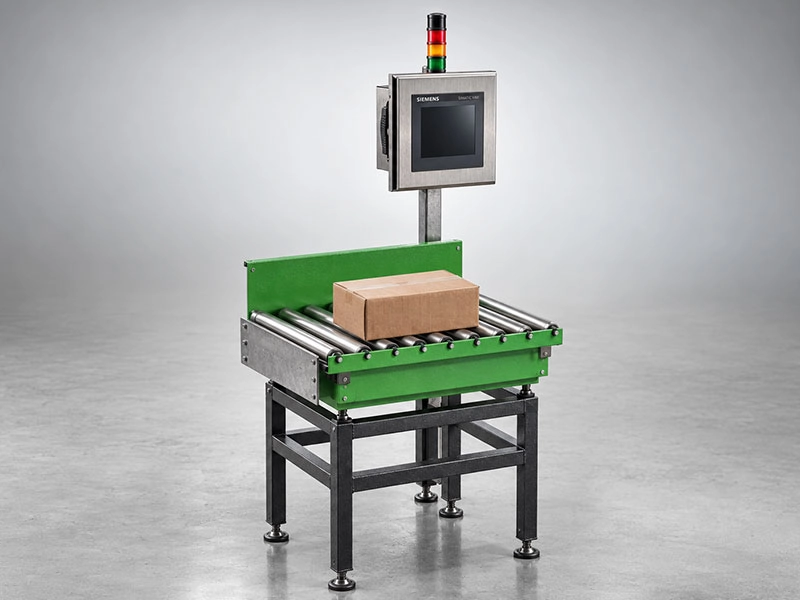
The CW automatic checkweigher weighs packs in motion as they pass along the production line and removes those that fall outside the target weight. It works with a 7-inch touch panel, memory for 100 product records, three-level user management and reporting to USB or a PC. Besides food and packaging lines, it suits white-goods and small hand-tool manufacturers who need to confirm that every box is complete.
The CW sits between two conveyors after the packing or cartoning machine and weighs each item individually without disturbing the flow of the line. The measured value is compared with the target weight and the lower and upper tolerance limits defined for that product. A pack within the limits carries on; a pack outside them is taken off the line automatically. How rejection is arranged is decided with the order, according to the pack’s weight, shape and the layout of the line.
Every weighing is also a count. The CW keeps separate totals for packs weighed, correct packs, packs over the upper limit and faulty packs, and it calculates the average pack weight. At the end of a shift you therefore see not only how many packs were rejected but also how far above or below target the filling ran on average. That second figure is the starting point for cutting product giveaway.
One of the CW’s main uses is products where many parts go into the same box. Think of a white-goods accessory pack, a hand-tool set, or a small appliance packed with its manual and fixings. Forgetting a part on the assembly line is a common mistake, and it goes unnoticed until the customer opens the box. When the whole box is weighed, a missing part shows up as a drop in total weight; the product reaches the consumer complete and the manufacturer’s reputation is protected.
Whether this approach will work can be worked out in advance. For example, if a complete box weighs between 2,390 and 2,410 g and the lightest part in it weighs 30 g, a box missing that part weighs 2,380 g at most. Setting the lower limit at 2,385 g separates incomplete boxes reliably from normal ones. If the lightest part were a 4 g washer, an incomplete box would land between 2,386 and 2,406 g and mix with the normal range; catching such a part by weight would not be dependable. The rule is simple: the part you are looking for must be clearly heavier than the weight spread between complete boxes. You can establish the real spread of your boxes by weighing a few dozen samples and send it to us before deciding. Remember that packaging adds to this spread as well: carton weight can vary from one supplier to another, and that difference has to be allowed for when comparing against the lightest part.
The CW stores 100 product records. Each holds the pack name, configuration details, target weight, upper tolerance and lower tolerance. When the product on the line changes, the operator picks the right record from the list without re-entering any values. For a plant packing dozens of different products on one line, this reduces a product change to a few taps and lowers the chance of running with the wrong values.
When setting tolerances, keep two different goals apart. If fill weight is being checked, the lower limit is set with the quantity declared on the pack and the spread of the filling machine in mind. If contents are being checked, the limits are chosen from the weight of the lightest part, as in the example above. The upper limit carries information too: an extra part in the box or two items riding on top of each other shows up as an over-limit pack.
Counter values are shown on the panel and can be exported as a report directly to a USB stick or a PC. From these reports the quality department reads how many packs were weighed for a given day or product, how many were rejected and where the average sat. When a customer complaint comes in, the records for that period are far firmer ground than handwritten notes.
One of the most frequent problems with checkweighers is tolerances being loosened without authority: opening the limits when rejects rise hides the problem instead of solving it. To guard against this, the CW offers three user levels, administrator, supervisor and operator, with up to 20 users defined. A common set-up lets operators only select products and leaves tolerance and record changes to the higher levels; which action is open to which level is agreed together during commissioning.
Weighing a moving pack is harder than weighing on a quiet scale; motors, neighbouring machines and the pack’s transfer onto the belt all add noise to the signal. The CW has a strong vibration filter that suppresses these fluctuations. Even so, for good results the installation point should be kept as far from vibration as possible: a press, compressor or vibratory feeder should not share the same frame, and the floor should be solid. Seeing photos of your line and its layout dimensions before installation makes it easier to choose the right spot.
For lines working close to open or packed food, the CW can optionally be built in stainless material with a hygienic frame design. On an assembly line carrying dry, boxed products, the standard construction is usually enough. Telling us how the line is cleaned and which product passes over it is enough to pick the right option.
Both models serve the same purpose: verifying pack weight. The CW is conceived as a full inspection station that weighs packs on the line and rejects wrong weights automatically, and it is the first model considered where the line has room for it. The MCW is designed for short, compact lines where space is tight. Share your line length, pack dimensions and items per minute and we will work out together which model fits.
The first question in deciding is how much of the line can be given over to the checkweigher; the second is where rejected packs should go. If there is room and wrong-weight packs are to leave the line by themselves, the CW is the natural choice. If only a short gap is left on an existing line, the MCW is considered. The speed and accuracy that can be reached are calculated for both models from pack size and line speed, which is why we work with your line’s data rather than a general figure. We reply to quotation requests within 3–4 hours.
Product selection, settings and counters are all handled from one touch screen.
Each record stores the pack name, configuration, target weight and lower and upper tolerance.
Total, correct, over-limit and faulty pack counts are tracked together with the average weight.
Up to 20 users are defined at administrator, supervisor and operator level.
Data is exported directly to a USB stick or a computer.
The effect of line and ambient shaking on the result is suppressed; stainless and hygienic frame options suit food lines.
| 10.1 ” Color touch HMI panel |
| Package name, configuration, target weight, upper tolerance |
| 100 formulas including weight and low tolerance weight |
| Total package, Correct package, Over package, Missing package, Average |
| Three levels of user management: Administrator / Manager / Operator |
| Max. Support up to 20 users |
| Direct reporting to USB or computers |
| Dynamic weighing with powerful vibration filtering |
| Stainless and PU materials suitable for food production |
| Hygienic chassis / body design |
| Extensive service network, 2 years warranty |
Packaged Foods
MedicinesA missing part lowers the box’s total weight. If the part in question is clearly heavier than the weight spread between complete boxes, the lower limit is set inside that gap and the incomplete box is rejected. For very light parts, a weight check alone may not be enough.
The CW stores 100 product records. Each is saved with its own name, target weight and tolerances, and on a product change the record is picked from the list.
That is governed by user levels. With administrator, supervisor and operator levels, tolerance changes can be restricted to authorised people; up to 20 users can be defined in the system.
Counter values can be saved directly to a USB stick or transferred to a computer, so quality and production teams can process the data in their own spreadsheets.
Even when few packs are rejected, an average sitting clearly above target means extra product is going into every pack. Watching the average makes it possible to spot this loss and bring the filling setting down.
Stainless material and a hygienic frame design are offered as options for food lines. Letting us know how the line is cleaned and whether the product passes open or packed is enough for the choice.
Quote requested forCW Checkweigher
Still with you after installation
Send repair, maintenance and calibration requests through the Technical Service page or by phone.