Skip to content
Send an e-mailMessage us on WhatsAppLinkedInInstagramFacebookRequest a Quote
+90 332 226 07 76Message us on WhatsApp
Bagging Machines

M-AF1 Auger Bagging Machine

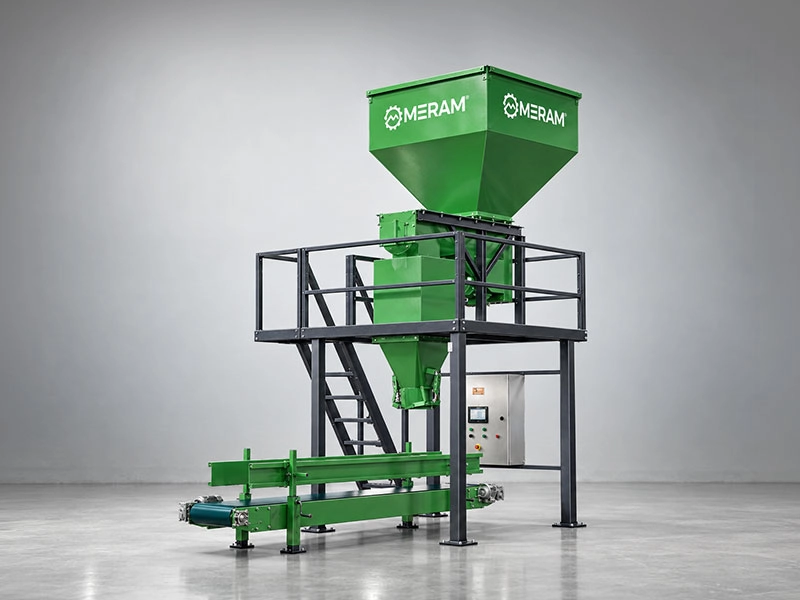
The M-AF1 auger bagging machine uses an auger to dose products that do not flow evenly on their own, such as flour, ground feed, mineral powders and granular powders, into bags anywhere from 5 kg up to 50 kg. It has the tightest tolerance in the range (±50–100 g), runs at about 270 bags per hour and is available in stainless steel. For mills, feed compounders and chemical businesses that handle dusty products and also need small bag sizes, it is the only option in the range.

Output capacity
6 – 7 / 6 – 7 t/h
Weighing accuracy
± 50 – 100 gr

Why do powders cause trouble in a gate?

Fine powders cause flow problems in two ways. Some form an arch-like bridge inside the hopper; the space below empties, but the product above does not come down and filling stops. Others behave like a liquid once mixed with air; they rush out uncontrolled the moment a gate opens and keep seeping past the edges after it closes. Either way, hitting the target weight becomes difficult and a dust cloud forms at the spout and around it.

On the M-AF1 the product is pushed towards the bag by the auger under the hopper. Because each turn of the auger carries roughly the same volume, flow depends on the auger’s speed rather than on how the product behaves. At the start of filling the auger turns fast, it slows near the target, and when it stops the flow stops too. With no free fall, the product entering the bag is aerated less and less dust spreads around.

What sets the M-AF1 apart in the range

  • Widest bag range: the other models are limited to 25–50 kg, while the M-AF1 also fills 5, 10, 15 and 20 kg bags. For packs sold at retail or to small businesses, this difference is decisive.
  • Tightest tolerance: at ±50–100 g it is the most accurate model in the range. Because the flow stops as soon as the auger stops, the amount of product in flight is small.
  • Stainless option: for food products, or powders that absorb moisture and can cause corrosion, product-contact surfaces can be specified in stainless steel.
  • Light, compact build: weighing 500 kg with a 200-litre hopper, it is the smallest machine in the range and fits easily under an existing silo or screw conveyor.

If your product is a free-flowing, coarse granule, you do not need the M-AF1; the gate model M-SF2 is a simpler solution at the same pace. The auger earns its place where product flow cannot be relied on by itself.

Accuracy and pace with small bags

Relating tolerance to bag weight shows what to watch with small bags. For example, 100 g on a 50 kg bag is two parts per thousand of the weight. On a 5 kg bag the same 100 g equals two percent. To avoid falling below the declared weight on small packs, the target is usually set slightly higher; how much higher is decided from the spread of your product in the first trials.

Small bags also affect pace differently. The table values of 270 bags per hour and 6–7 t/h match bags of around 25 kg (270 × 25 = 6,750 kg). As bags get smaller, the operator’s time to put each bag on stays the same, so the tonnage handled per hour falls. For 5 kg packs, planning capacity in bags rather than tonnes gives a more accurate picture.

Installation and feeding

The 200-litre hopper assumes the machine is fed continuously, like an intermediate bin. For example, if flour is taken at roughly 0.5–0.6 kg per litre, the hopper holds 100–120 kg of product, a buffer of four or five 25 kg bags. That is why the M-AF1 is usually installed at the end of a screw conveyor connected to a silo outlet, or under an intermediate bin that feeds product down continuously. The hopper volume is defined as variable; if feeding is intermittent, a larger hopper can be considered.

On the utilities side, plan for a three-phase 400 VAC, 50–60 Hz connection and an air supply at 8–10 bar; the table pairs this with a 300-litre compressor. In a dusty environment, a bag holder that grips the bag firmly throughout filling and a dust extraction connection on the spout greatly improve cleanliness around the machine.

Cleaning and product changeover

Powders stick to the auger flights and hopper walls and build up. Especially in humid weather, or with ground products containing oil, this build-up gradually narrows the flow and changes the amount the auger carries per turn. Cleaning the hopper and auger housing at the end of the shift is the shortest route to keeping filling accuracy. If you switch between products that contain allergens or must not mix, it is worth discussing at the quotation stage whether the auger can be removed for cleaning.

Key features

Positive feeding by auger

Powders that bridge, or aerate and flow like a liquid, are pushed into the bag under control by the auger speed.

Six bag sizes from 5 to 50 kg

Bag weights of 5, 10, 15 or 20 kg as well as 25 and 50 kg; the only model in the range that fills small packs.

±50–100 g accuracy

When the auger stops, the flow stops; with less product in flight, the tolerance narrows.

Stainless steel option

For food and corrosive powders, product-contact surfaces can be made of stainless steel.

Less dust

With no free fall, less dust rises from the bag and around the mouth during filling.

Compact 500 kg frame

With its 200-litre hopper it fits under an existing silo or conveyor outlet.

Technical Specifications

Product type Powder products
Maximum weighing weight Variable
Weighing range options 5 - 10 - 15 - 20 - 25 – 50 Kg
Weighing accuracy ± 50 – 100 gr
Upper hopper capacity 200 litres (Variable)
Weighing system LoadSync™ TouchCommand™ Display
Output capacity 6 – 7 / 6 – 7 t/h
Bagging rate 270 – 270 bags / hour
System pressure (300lt. compressor) 8-10 Bar
Power supply (VAC) (±%5-10%) 400 VAC / 50-60Hz
Weight 500 Kg

Applications

  • Food and Chemical Production

Frequently asked questions

Which powders is the M-AF1 used for?

Its design targets fine and granular powders of medium to high bulk density, as well as milled products. Flour, ground feed and mineral powders are typical examples. If you are unsure how your product flows, we assess it from a small sample.

Do 5 kg bags need a separate machine?

No. The same M-AF1 handles every step from 5 kg to 50 kg; switching is done by changing the target weight on the panel. If bag mouth sizes differ greatly, the suitability of the spout is checked separately.

When is the stainless option needed?

Stainless product-contact surfaces are preferred for food products and for powders that absorb moisture and can attack surfaces. With dry mineral powders the standard build is often enough.

Does output drop with very light powders?

Yes, it can. The auger carries a set volume per turn; if the product is light, that volume weighs fewer kilograms and reaching the target takes longer. That is why we ask for the product’s bulk density at the quotation stage.

M-AF1 or a gate model for granular fertiliser?

For free-flowing products such as granular fertiliser, the gate model M-SF2 is a simpler mechanism. The M-AF1 makes sense when the fertiliser is in powder form or its flow is irregular.

How often should the auger be cleaned?

With sticky, oily or moist powders, at the end of every shift; with dry, free-flowing powders, less often. When build-up changes the amount the auger carries, the spread of bag weights widens; that is a practical sign that cleaning is due.

Request a Quote

Quote requested forM-AF1 / Auger Bagging Machine

Bag weight (optional)

Your details are used only to reply to your request. Privacy Notice

Still with you after installation

Send repair, maintenance and calibration requests through the Technical Service page or by phone.

Technical service request

Related Products

Bagging Machines