Bagging machines for grain, fertiliser, pellets, coal and powders. 5–50 kg bags, ±50–200 g accuracy. Let us help you choose the right model.

M-DF1Double Gate Bagging Machine

M-DB1Double Belt Bagging Machine

M-SF1Single Gate Bagging Machine

M-SB1Single Belt Bagging Machine

M-SF2Economical Single Gate Bagging Machine

M-AF1Auger Bagging Machine

M-DB2-2LTwo-Station Double Belt Bagging Machine ProBBF big bag filling machine for powders and granules: 500–2000 kg bags, 15–30 bags an hour, fed by gravity, belt or auger.
All Big Bag Filling Machines modelsWeigh-based liquid filling machine for jerrycans, tins, pails and drums: two-stage fast and slow filling, net or gross mode, Ex-proof option.
All Liquid Filling Machines modelsTruck scales for surface or pit installation, with steel-reinforced concrete, I-beam or V-beam steel decks. 6–22 m long, 40–100 t capacity.

WB-X800FI-Beam Steel Platform Truck Scale

WB-X600V-Beam Bridge Type Truck Scale

WB-X800PI-Beam Steel Pit Type Truck Scale

WB-X400PSteel-Reinforced Pit Type Truck Scale

WB-X400FSteel-Reinforced Concrete Truck ScaleCheckweighers that weigh every pack in motion and reject under- and overweight packs: CW, and MCW for compact lines. Rejection, reporting, retrofit.
All Checkweighers modelsHeavy-duty floor scales: CP, TP, U-type pallet scale, MB modular, steel bar and marble scales. Four OIML R60 C4 load cells, sized to the load.
All Heavy Duty Scales modelsBS single load cell platform scale: 30 kg–1.5 t, double-chassis electronic construction and dual-range weighing for bench and packing use.
All Bench Scales modelsMonorail scales for abattoirs and meat plants: carcasses are weighed on the rail. Fitted to your existing line, stainless or galvanised.
All Monorail Scales modelsLivestock scales for cattle, sheep, goats and sacrifice shares: the 80 mm low-profile BBH, gated KBH and a 7-point share scale.
All Livestock Scales modelsBK belt weigher for weighing bulk material on the conveyor without stopping the line: 800–2000 mm belts, flows up to 6000 t/h.
All Belt Weighers modelsFarms, feedlots and grain businesses.
Weighbridge yards, warehouses and dispatch.
Packing, filling and end-of-line checking.
Bulk material and vehicle weighing.
Liquid and powder filling.
Vehicle and platform weighing.
Surface and pit-mounted weighbridges for trucks and tractors.
Cattle and small livestock; low platforms for the farm.
Floor scales, pallet scales and single-cell platform scales.
Continuous flow and totalised weight on the belt.
Bag, big bag and liquid filling; automatic weighing lines.
Weighs packed products in line and rejects under- and overweight.

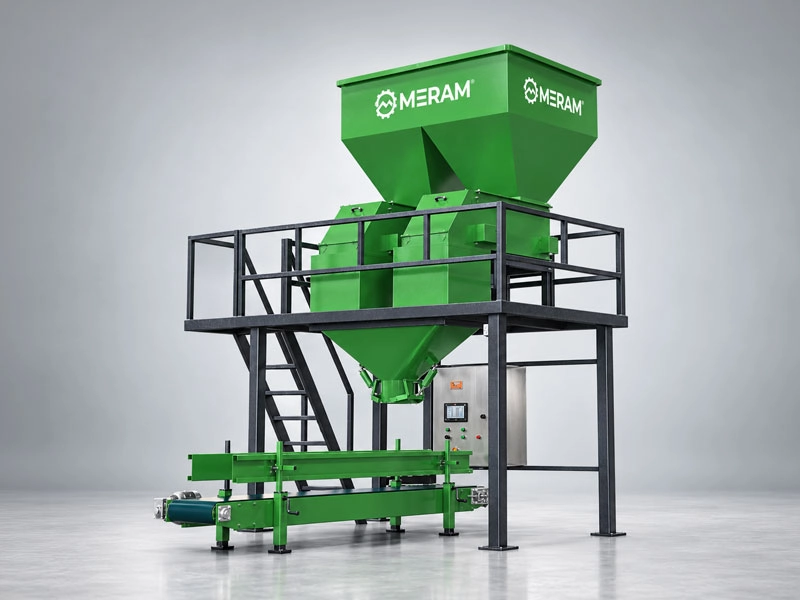
The M-DB1 double-belt bagging machine is a high-output machine that uses two feed belts to move coarse or fragile material such as pellets, coal and pumice into its weigh hopper before discharging it into 25–50 kg bags. Its pace is 400–750 bags per hour, offers ±50–150 g accuracy and, with its 3000-litre top hopper, suits intensive filling that goes on all day. It was developed for pellet plants, coal packing facilities and pumice operations where the pace of the single-belt model is not enough.
In a belt machine, filling time is set by two phases: coarse flow, in which most of the bag is filled quickly, and fine flow, which slows down as the target approaches. With one belt, both phases run over the same belt, which turns either fast or slow. Speeding up the belt to shorten the coarse phase lengthens the braking distance in the fine phase.
The M-DB1 has two belts. During coarse filling both belts run together and raise the total flow into the weigh hopper. As the target weight approaches, one belt can be stopped and the other slowed so that the last part is completed with a fine stream. This shortens the coarse phase and frees control of the last grams from the speed of a single belt. That is where the “finer dosing” in our short description comes from.
600 bags an hour means one bag every 6 seconds (3,600 / 600 = 6). At a single spout, the empty bag must be put on, the bag holder closed, filling completed and the full bag released onto the conveyor within that time. That is why, on M-DB1 installations, the bag placing point, sewing machine and conveyor are sized together to run at the same speed.
On the product side, continuous feeding matters too. For example, if pellets are taken at roughly 0.6–0.7 kg per litre, the 3000-litre hopper holds about 2 tonnes of pellets; at 15 tonnes an hour that is a buffer of around 8 minutes. The flow rate of the elevator or conveyor filling the hopper must not fall below the machine’s hourly consumption; otherwise the hopper slowly empties and the machine starts to wait.
The machine weighs about 2,300 kg; with a full hopper, the load on the support structure rises to several tonnes. The platform or floor it stands on must therefore be planned for that load. If the machine is mounted on a steel platform, remember to leave safe access around it for servicing the belts and weigh hopper. The electrical connection is 400 VAC, 50–60 Hz, three-phase, with ±5–10% mains deviation accepted. Compressed air at 8–10 bar drives the pneumatics, with a 300-litre compressor listed as the reference. In high-pace operation, where both belts and the bag holder move frequently, it is especially important that the compressor is rated for continuous duty.
With dusty products such as coal and pumice, adding a dust extraction connection to the spout makes both the operator’s surroundings and cleaning around the belts and weigh hopper easier.
Maintenance on a two-belt machine resembles that of the single-belt model, but the two belts must be kept in similar condition. If one belt is slacker or has product built up on its surface, the amounts the two belts carry during coarse filling become unbalanced and the fine phase gets longer. Weekly checks of tension and tracking, the state of the scrapers and cleaning of the weigh hopper keep that balance. When abrasive pumice is handled, the belt surfaces should be inspected more often. Scheduling maintenance so that both belts are checked on the same day makes any difference between them easier to notice and avoids separate stoppages.
Both belts run together in coarse filling; in fine filling the flow is controlled more precisely.
The highest pace among single-station belt machines; handles around 17–22 t/h of product.
Coarse, angular and fragile products travel on the belt instead of being trapped at a gate edge.
Holds roughly 2 tonnes of pellets, so brief hiccups in elevator feeding do not interrupt filling; the volume can be adapted to the layout.
Even at high output, 25–50 kg bags approach the target weight under control.
Bag weight and calibration are set on the touch panel, so a new operator learns the machine quickly. When the product batch changes, the fine filling point is settled again with a few trial bags.
| Product type | Pellets, coal, etc. |
| Maximum weighing weight | Variable |
| Weighing range options | 25 – 50 Kg |
| Weighing accuracy | ± 50 – 150 gr |
| Upper hopper capacity | 3000 litres (Variable) |
| Weighing system | LoadSync™ TouchCommand™ Display |
| Output capacity | 19 – 22 / 17 – 19 t/h |
| Bagging rate | 750 – 400 bags / hour |
| System pressure | (300lt. compressor) 8-10 Bar |
| Power supply (VAC) | (±%5-10%) 400 VAC / 50-60Hz |
| Weight | 2.300 Kg |
Food and Chemical ProductionThe number of feed belts and the output that follows from it. The M-SB1 fills 250–400 bags per hour, the M-DB1 400–750. With its 3000-litre hopper and 2,300 kg frame, the M-DB1 is also physically bigger.
Look at how long the operator takes to put a bag on at the filling point. If bags can be placed fast enough at one spout, the M-DB1 is enough. If bag placing slows the line, the two-station line that splits filling between two spouts is the better fit.
Belt feeding also works with grain, but for free-flowing granular products the double-gate M-DF1 in the same output class is a simpler mechanism. The M-DB1’s advantage shows with coarse and fragile products.
The top end applies to light bags such as 25 kg and evenly flowing product. With 50 kg bags the pace falls back towards 400 an hour, while the flow in tonnes stays similar.
The bag is held tightly on the spout by a pneumatic holder throughout filling. A dust extraction connection on the spout collects the coal dust that rises with the air leaving the bag, right at its source.
The belts share one control system, and coarse and fine filling are set up around the two belts working together. Regular checks of belt tension and drive parts are therefore the most effective way to prevent unexpected stoppages.
Quote requested forM-DB1 / Double Belt Bagging Machine
Still with you after installation
Send repair, maintenance and calibration requests through the Technical Service page or by phone.