Bagging machines for grain, fertiliser, pellets, coal and powders. 5–50 kg bags, ±50–200 g accuracy. Let us help you choose the right model.

M-DF1Double Gate Bagging Machine

M-DB1Double Belt Bagging Machine

M-SF1Single Gate Bagging Machine

M-SB1Single Belt Bagging Machine

M-SF2Economical Single Gate Bagging Machine

M-AF1Auger Bagging Machine

M-DB2-2LTwo-Station Double Belt Bagging Machine ProBBF big bag filling machine for powders and granules: 500–2000 kg bags, 15–30 bags an hour, fed by gravity, belt or auger.
All Big Bag Filling Machines modelsWeigh-based liquid filling machine for jerrycans, tins, pails and drums: two-stage fast and slow filling, net or gross mode, Ex-proof option.
All Liquid Filling Machines modelsTruck scales for surface or pit installation, with steel-reinforced concrete, I-beam or V-beam steel decks. 6–22 m long, 40–100 t capacity.

WB-X800FI-Beam Steel Platform Truck Scale

WB-X600V-Beam Bridge Type Truck Scale

WB-X800PI-Beam Steel Pit Type Truck Scale

WB-X400PSteel-Reinforced Pit Type Truck Scale

WB-X400FSteel-Reinforced Concrete Truck ScaleCheckweighers that weigh every pack in motion and reject under- and overweight packs: CW, and MCW for compact lines. Rejection, reporting, retrofit.
All Checkweighers modelsHeavy-duty floor scales: CP, TP, U-type pallet scale, MB modular, steel bar and marble scales. Four OIML R60 C4 load cells, sized to the load.
All Heavy Duty Scales modelsBS single load cell platform scale: 30 kg–1.5 t, double-chassis electronic construction and dual-range weighing for bench and packing use.
All Bench Scales modelsMonorail scales for abattoirs and meat plants: carcasses are weighed on the rail. Fitted to your existing line, stainless or galvanised.
All Monorail Scales modelsLivestock scales for cattle, sheep, goats and sacrifice shares: the 80 mm low-profile BBH, gated KBH and a 7-point share scale.
All Livestock Scales modelsBK belt weigher for weighing bulk material on the conveyor without stopping the line: 800–2000 mm belts, flows up to 6000 t/h.
All Belt Weighers modelsFarms, feedlots and grain businesses.
Weighbridge yards, warehouses and dispatch.
Packing, filling and end-of-line checking.
Bulk material and vehicle weighing.
Liquid and powder filling.
Vehicle and platform weighing.
Surface and pit-mounted weighbridges for trucks and tractors.
Cattle and small livestock; low platforms for the farm.
Floor scales, pallet scales and single-cell platform scales.
Continuous flow and totalised weight on the belt.
Bag, big bag and liquid filling; automatic weighing lines.
Weighs packed products in line and rejects under- and overweight.

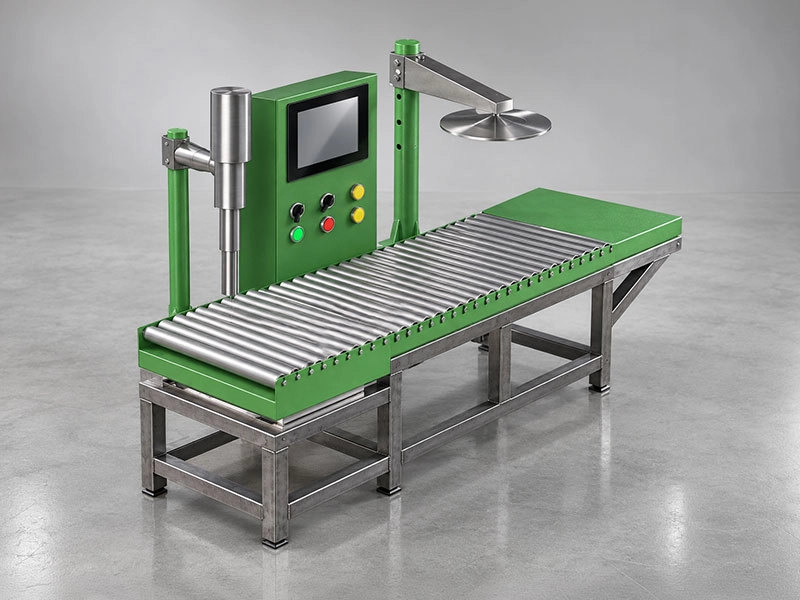
The LF liquid filling machine is a weigh-based filling system that automatically fills tins, jerrycans, pails and similar containers by weight in food and chemical plants. In its standard configuration it is designed for fills between 10 and 30 kg; it fills in two stages, fast and slow, and can work net or gross. It suits producers who sell paint, chemicals or food liquids by the kilogram and want to move from hand filling to an automatic filling station.
The empty container is placed on the 400 × 400 mm weighing platform and positioned under the filling nozzle. If net filling is selected, the machine first tares the container; in gross mode container and contents are targeted together. The valve then opens wide and the container starts filling in the fast stage. As the weight approaches the target, the valve throttles back, the last portion is completed in the slow stage and flow is cut at the target value. The container is lifted off and the next one takes its place.
The point of two stages is this: with a single-speed valve you sacrifice either speed or accuracy. On the LF the bulk of each fill goes in quickly, which keeps the cycle short, while the last grams arrive at a low rate so filling stops without overshooting. Weight is followed with a 10 g resolution; on a 20 kg tin, for example, that is a reading step of about one two-thousandth of the target.
In the standard configuration the container is defined as at most 400 mm in diameter and 500 mm high; the weighing platform is 400 × 400 mm and the maximum capacity is 30 kg. These dimensions cover the tins used for paint and varnish, 20-litre jerrycans and pails. When the fill weight drops below 10 kg or the container exceeds these dimensions, a 200-litre drum for instance, the platform and capacity have to be reviewed for your container. That is why we ask for container size and fill weight together before quoting.
With a narrow-neck jerrycan, the nozzle has to fit into the neck without effort and the lightweight plastic container must not shift during filling; with a wide pail, the liquid should go in without splashing. These points are about the fit between container and nozzle rather than the machine itself, and they are set up for your container during installation.
The LF’s filling rate is given as 120–240 containers per hour, which works out at roughly a 15–30 second cycle per container. Three things decide whether you run near the top or the bottom of it: how runny the liquid is, the fill weight and how quickly containers are put on and taken off the platform. With a water-thin product the fast stage is short; a thick filler paint takes longer to fill the same container.
A quick example helps you size your need: filling 180 tins of 20 kg an hour means 3.6 tonnes of product an hour. If your daily target is 25 tonnes in an 8-hour shift, that is about 3.1 tonnes an hour, or 156 containers of 20 kg an hour, which sits inside the range. If the target goes beyond 240 containers, a second station or a container feed arrangement should be discussed.
The LF runs on electricity and compressed air. Air pressure must be in the 0.4–0.8 MPa range (about 4–8 bar); if your plant has no compressed-air line, it has to be added to the installation plan. Power supply is AC 110 V or 220 V, 50/60 Hz. The operating temperature range is −10 °C to 40 °C; keep this in mind if the station will run in an unheated warehouse or a hot filling area in summer.
For stable readings, the weighing platform should stand on a solid floor free of vibration. Shaking from pumps, mixers or forklift traffic directly affects accuracy at the end of the fill, so the station is placed away from such sources where possible. Setting each container down in the same spot on the platform also improves repeatability; a simple mark or guide on the platform is usually enough for this.
The filling valve is chosen in AISI 304 or AISI 316 stainless steel. As a rule, 304 is sufficient for food liquids and products with low corrosivity; for products containing salt or chlorides, or more aggressive chemicals, molybdenum-bearing 316 is preferred. Telling us the chemical make-up of your product is enough to pick the right material.
If solvent-based paint, thinner or similar hazardous substances are filled, the LF is configured with the Ex-proof option. In that case you need to state the plant’s hazardous-area zone at the quotation stage; the equipment is chosen on that basis.
The container fills in the fast stage and switches to the slow stage near the target, keeping the cycle short without overshooting.
Either the contents alone, with the container tared off, or container and contents together can be targeted.
Fills between 10 and 30 kg are followed in 10 g steps.
The valve is selected in AISI 304 or AISI 316 to match the product.
Equipment suited to explosive atmospheres can be specified for filling hazardous substances that give off flammable vapour.
The 400 × 400 mm platform takes containers up to 400 mm in diameter and 500 mm high, so the station fits into a tight filling area.
| The following information is provided for the sample machine, it can be configured at the desired capacity. |
| Max. Capacity: 30kg |
| Sensitivity: 10g |
| Filling Capacity: 10 ~ 30kg |
| Filling Accuracy: 0.1 0.1% |
| Filling Speed: 120 ~ 240 Bucket / hour |
| Up / Down Range: 0-50mm (H) |
| Platform: 400X400mm |
| Bucket Dimensions: ≤φ400 × h500mm |
| Air Pressure: 0.4 ~ 0.8Mpa |
| Filling Valve: Material: AISI 304/316 |
| Power: AC 110V / 220V, 50 / 60Hz, 10A |
| Operating Temperature: -10 ° C to 40 ° C |
| Extensive service network, 2 years warranty |
Food and Chemical ProductionThe standard configuration is for containers of up to 30 kg and 400 mm diameter × 500 mm height; a 200-litre drum falls outside these dimensions. If you plan to fill drums, send us the drum size and fill weight and we will assess suitability together at the quotation stage.
The filling rate is 120–240 containers per hour. Runny products and layouts with quick container changes approach the upper figure; thick products and heavy containers move towards the lower one.
The LF’s pneumatic components run on compressed air, and the technical data call for 0.4–0.8 MPa. Clean, dry air at this pressure has to be brought to the station; if your line lacks sufficient air, compressor capacity is added to the installation plan as well.
For food liquids and non-corrosive products, 304 is usually enough. For salty, chloride-bearing or acidic products, 316 holds up better. The product’s safety data sheet is the most reliable basis for the decision.
The operating temperature is −10 °C to 40 °C. Bear in mind, though, that many liquids thicken in the cold and filling takes longer, so winter output should be calculated with that effect in mind.
The mode is selected in the machine settings. Net filling is used when the label states net weight, gross filling when the total shipping weight matters; both methods can be used on the same machine.
Quote requested forLF Liquid Filling Machine
Still with you after installation
Send repair, maintenance and calibration requests through the Technical Service page or by phone.