Skip to content
Send an e-mailMessage us on WhatsAppLinkedInInstagramFacebookRequest a Quote
+90 332 226 07 76Message us on WhatsApp
Heavy Duty Scales

Steel Bar and Sheet Scale

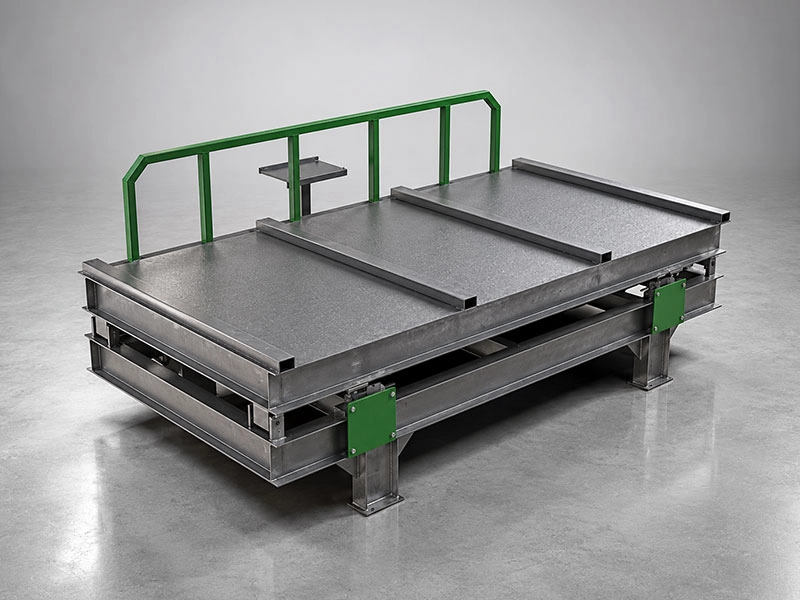
The steel bar and sheet scale is a double-chassis scale built with a long platform to weigh reinforcing bar, sections, tubes and sheet bundles. It comes in capacities from 1,500 kg to 15,000 kg and platform sizes up to 150 × 600 cm, with 4, 6 or 8 OIML R60 load cells underneath depending on its size. It is designed for steel and flat-rolled mills and for wholesale and retail outlets selling steel bar and sheet.

Capacity
1.5 t – 15 t
Dimensions
120×120 – 150×600 cm
Options
5 models

Why do steel bar and sheet need a scale of their own?

In the steel trade, the load being weighed differs from a warehouse pallet in three ways. The first is length: reinforcing bar and sections usually arrive longer than the platform. The second is density: steel carries a great deal of weight in a very small volume and puts that weight on a narrow strip of the platform. The third is the way it is loaded: bundles are usually set down by crane, hook or forklift, and the moment of landing involves impact.

The steel bar and sheet scale is built with a double-chassis platform to meet these three conditions. The materials used in the platform are dimensioned to withstand a load at least 200 per cent above the scale’s capacity. That margin is there not for the weight being measured but for the impact as a bundle lands and for the load concentrating at a single point. The surface is protected with electrostatic oven-baked paint; given the abrasive effect of mill scale and dust in a rolling mill, damaged paint should be repaired promptly.

Choosing capacity and platform length together

On this scale, capacity and platform length are not chosen separately; the technical table gives suitable sizes for each capacity. A practical way to read it:

  • 1,500 kg: 120 × 120 and 120 × 150 cm. For weighing cut pieces, cut sheet and small sections in retail sales.
  • 3,000 kg: from 120 × 150 cm to 120 × 240 cm. For bundle weighing at hardware stores and smaller steel dealers.
  • 6,000 kg: from 120 × 180 cm to 150 × 300 cm. For medium-sized bundles in wholesale trade and at workshop goods-in.
  • 10,000 and 15,000 kg: from 120 × 240 cm to 150 × 600 cm. At mill exits, in large stockyards and for sheet packs.

As the platform gets longer, the number of load cells rises too. On short platforms four cells, one at each corner, carry the load evenly; on a platform stretching to 4 or 6 metres, cells added at intermediate points let a bundle placed in the middle be carried without the deck bending. Domestically produced OIML R60 load cells are used. Where the listed options fall short, dimensions and capacity can be specified to order.

Long bar, sagging sheet: setting the platform length

A load longer than the platform does not always mean a wrong reading. Both ends of a tightly strapped bundle that does not bend may stick out beyond the platform; provided those ends are in free air and the bundle’s balance point lies within the deck, the scale still sees the full weight. The trouble starts when the load flexes under its own weight and rests on the floor or a nearby trestle; at that moment part of the weight escapes off the scale.

For this reason, platform length is set not by the top-selling product but by the product that sags most easily. Small-diameter rebar, thin sheet packs and long slender sections are the most critical loads in this respect. If a business sells both short cut pieces and full-length bundles, a long platform such as 150 × 400 cm or 150 × 600 cm covers both needs. Centring the load on the platform every time and checking by eye that its ends hang free is the most important habit to teach the operator.

Use in sales: piece counting, records and tickets

In steel and sheet sales the weighing result goes straight onto the invoice. The indicator’s RS 232 output lets each weighing be printed as a ticket or label and the record passed to a computer, so no copying errors creep in between the weighbridge ticket and the delivery note. Since every sale priced by weight falls under weights and measures legislation, periodic inspection of the scale should be planned from the start.

The indicator’s piece counting function can be used to check quantities of bars of the same diameter and length. First a set number of bars is weighed to teach the indicator the unit weight, then the whole bundle is weighed and the indicator works out the count. For example, if a bundle of bars weighing about 19 kg each reads 1,140 kg, the bundle holds about 60 bars. Because rolling tolerances make individual bar weights differ slightly, this result should be treated as a quick check, not an exact count.

Key features

Long, double-chassis platform

Platform options from 120 × 120 cm to 150 × 600 cm are chosen long enough to carry bar and section bundles without sagging.

Built for at least 200 per cent above capacity

Platform materials are chosen to withstand at least 200 per cent more than the rated capacity, absorbing the impact of a bundle set down by crane.

4, 6 or 8 load cells

The number of cells rises with size and capacity, so a long platform carries the load evenly wherever it is placed.

Capacities from 1.5 to 15 tonnes

Five capacity steps cover everything from a retail outlet to a mill exit; custom sizes and capacities are also possible.

Piece counting

For bars whose unit weight has been entered, the indicator works out the approximate number in a bundle.

Ticket, label and computer records

Over the RS 232 link each weighing is printed as a ticket or label and passed into the sales record.

Technical Specifications

MODEL  CAPACITY (TON) DIMENSIONS (cm)
DB 1500 kg x 0.5 kg 120x120 cm – 120x150 cm
DB 3000 kg x 1 kg 120x150 cm – 12x180 cm – 120x200 cm – 120x240 cm
DB 6000 kg x 2 kg 120x180 cm – 120x200 cm – 120x240 cm – 150x300 cm
DB 10000 kg x 5 kg 120x240 cm – 150x300 cm – 150x400 cm – 150x600 cm
DB 15000 kg x 5 kg 120x240 cm – 150x300 cm – 150x400 cm – 150x600 cm

Applications

  • Iron, Steel and Sheet Metal Trading
  • Flat Plate Production Plant
  • Iron and Steel Production Plant

Frequently asked questions

Can 12-metre rebar be weighed on a 6-metre platform?

Yes, if the bundle is tightly strapped and stiff, it is centred lengthwise on the deck and both protruding ends stay clear of everything. With small-diameter bar, the ends can sag under their own weight and touch the floor; the reading then comes out short. Check that the ends hang free at every weighing.

How many load cells are needed?

The cell count is set by the platform size and capacity. Four cells are enough on short platforms; on long ones the number rises to six or eight so the load is carried without bending.

Does setting bundles down by crane damage the scale?

The platform is made from materials that withstand at least 200 per cent above capacity. Even so, lowering the bundle slowly and reading the value only once the sling is fully slack matter both for cell life and for a correct result.

Can sheet packs and coils be weighed on this scale too?

Yes. Flat-rolled mills and sheet outlets are among the uses of this scale. For heavy sheet packs, include the weight of the bearers and packaging under the pack when choosing capacity.

Can piece counting give an exact bar count?

Piece counting is a quick, practical check, but bars of the same diameter vary slightly in weight because of rolling tolerances. Treat the result as an approximate count, and count the bundle separately where an exact figure is needed.

Which capacity should I choose for a sales outlet?

Take the heaviest bundle you will weigh in one go and leave a margin above it. For a retailer selling pieces and cut lengths, 1,500 kg or 3,000 kg is usually enough; wholesalers selling full-length bundles and sheet packs look at 6,000 kg and above.

Request a Quote

Quote requested forSteel Bar and Sheet Scale

Capacity (optional)

Your details are used only to reply to your request. Privacy Notice

Still with you after installation

Send repair, maintenance and calibration requests through the Technical Service page or by phone.

Technical service request

Related Products

Heavy Duty Scales