Skip to content
Send an e-mailMessage us on WhatsAppLinkedInInstagramFacebookRequest a Quote
+90 332 226 07 76Message us on WhatsApp
Bagging Machines

M-SF1 Single Gate Bagging Machine

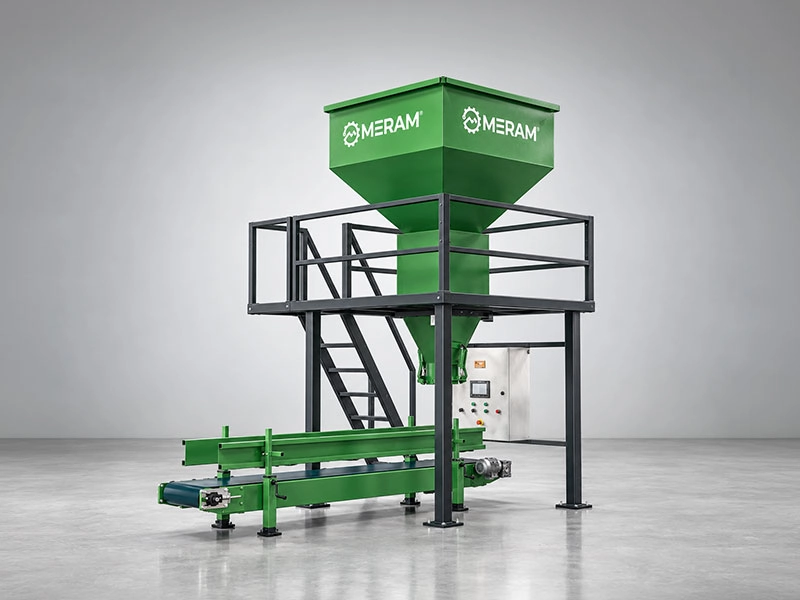
The M-SF1 single-gate bagging machine is a single-station machine that weighs wheat, barley, maize, seed, granular fertiliser and other products that flow under their own weight into 25–50 kg open-mouth bags. It runs at 200 to 440 bags per hour with a filling accuracy of ±50–150 g. It is the middle step of the gate range: right for grain stores, traders and fertiliser businesses that have outgrown the economical model but do not yet need the large double-hopper machine.

Weighing range
25 – 50 Kg
Output capacity
9 – 12 / 9 – 11 t/h
Weighing accuracy
± 50 – 150 gr

How the M-SF1 works

Product waits in the 1800-litre hopper at the top of the machine. When the gate beneath the hopper opens, the grain pours freely into the weigh hopper, which reports every kilogram that enters to the weighing system. Most of the fill happens quickly with the gate wide open; a few hundred grams before the target the opening is reduced and the rest is completed with a thin stream. Once the set weight is reached the gate closes and the product in the weigh hopper drops into the bag below.

The M-SF1 has a single weigh hopper. While it is discharging into a bag, the next weighing cannot start; weighing and discharge follow each other in turn. That is what sets the machine’s hourly limit. On the double-gate M-DF1, two hoppers alternate, so this wait disappears. Choosing between the two models really comes down to one question: is this waiting time acceptable for your output?

Where the M-SF1 sits among its siblings

All three gate models serve the same product group; they differ in output, hopper volume and accuracy:

  • M-SF1 instead of M-SF2: the economical model stays at 270 bags per hour, has a 500-litre top hopper, and its weight tolerance is ±50–200 g. The M-SF1 reaches up to 440 bags per hour, its 1800-litre hopper absorbs fluctuations in the flow from the silo better, and its tolerance is tighter. If you sell to buyers who insist on close bag weights, that difference matters directly.
  • M-SF1 instead of M-DF1: the double-hopper model reaches 750 bags per hour, but it is a larger machine weighing 2,300 kg with a 3000-litre hopper. If your daily target stays below 440 bags per hour, the M-SF1 takes up less room, sits on a lighter support structure and, with one hopper, is simpler to set up.
  • M-SF1 instead of the belt models: coarse coal, pumice or pellets that crumble easily can cause trouble at a gate. For small, regular grains that flow without jamming, however, a gate is a simpler mechanism than belt feeding.

Converting bags into tonnes

The technical table gives capacity both in bags and in tonnes; the link between them is the bag weight. Lighter bags mean more bags per hour, heavier bags fewer, while the amount of product moved stays similar. For example, 440 bags of 25 kg make 11 tonnes an hour; 200 bags of 50 kg make 10 tonnes an hour. The 9–12 t/h range in the table matches this calculation.

Planning by shift is more realistic. For example, if breaks, restocking empty bags and short stops add up to one hour in an 8-hour day, net running time is 7 hours. Assuming 400 bags of 25 kg per hour, the day ends with 2,800 bags, or 70 tonnes of grain. If your target is clearly above that, look at the double-hopper model; if it is below, the M-SF1 leaves a comfortable margin.

Installation, power and compressed air

The machine weighs about 1,400 kg and is usually placed under a silo or feed conveyor. Because the top hopper volume is listed as variable, a different size can be discussed at the quotation stage to suit your feeding arrangement. It needs a 400 VAC, 50–60 Hz three-phase supply and tolerates a ±5–10% deviation in mains voltage. The gate and bag holder are pneumatic, so an air line delivering 8–10 bar is essential; the table assumes a 300-litre compressor for this.

The key layout question is where the bag goes after the spout. If the full bag moves on to a conveyor and then a sewing machine, the spout height and the conveyor height must be planned together. We work out the layout dimensions with you from a drawing of your plant or a few photographs.

Daily use and maintenance

The target weight is entered on the touchscreen control panel; switching from 25 kg to 50 kg involves no mechanical changes. Calibration is carried out from the same panel. At the end of each shift, dust and broken grains collected on the gate edges and inside the weigh hopper should be cleaned off; every gram that sticks to the hopper comes back as a deviation in the next bag. Draining the water trap on the air line regularly extends the life of the pneumatic cylinders. A good weekly habit is to check one filled bag on an independent scale and confirm the machine still hits its target.

Key features

One gate, one weigh hopper

A plain mechanical design; setup and maintenance revolve around a single hopper, so operator training is short.

200–440 bags per hour

Covers medium daily volumes in grain; 25 kg bags approach the upper end, 50 kg bags the lower end.

±50–150 g filling accuracy

Two-stage filling approaches the target; with uniform grain the result sits near the lower end of the range.

1800-litre top hopper

Buffers short interruptions in the feed line so the machine waits idle less often; the volume can be changed to suit.

Touchscreen control panel

Target weight entry and calibration are done on the same screen; changing bag weight takes seconds.

Built for four sectors

Used with free-flowing granular products in agriculture, food, petrochemicals, and construction and mining.

Technical Specifications

Product type Grains
Maximum weighing weight Variable
Weighing range options 25 – 50 Kg
Weighing accuracy ± 50 – 150 gr
Upper hopper capacity 1800 litres (Variable)
Weighing system LoadSync™ TouchCommand™ Display
Output capacity 9 – 12 / 9 – 11 t/h
Bagging rate 440 – 200 bags / hour
System pressure (300lt. compressor) 8-10 Bar
Power supply (VAC) (±%5-10%) 400 VAC / 50-60Hz
Weight 1.400 Kg

Applications

  • Food and Chemical Production

Frequently asked questions

How many tonnes of grain can the M-SF1 bag per hour?

About 9–12 t/h according to the table. The exact figure depends on bag weight and how the product flows: 440 bags of 25 kg make 11 tonnes, 200 bags of 50 kg make 10 tonnes an hour.

When should I choose the M-SF1 over the M-SF2?

If you need more than 270 bags per hour, want a bag weight tolerance no wider than ±150 g, or need a large buffer hopper because your feed line runs intermittently, the M-SF1 is the better fit.

What if my requirement goes above 440 bags per hour?

The single-hopper design cannot go beyond that limit. In that case we look at the M-DF1, which works up to 750 bags per hour with two weigh hoppers. Adding a second machine beside an existing M-SF1 is another option; we decide together which suits your silo layout.

Can the M-SF1 fill pellets or coal?

A gate can handle small, regular grains that flow without jamming. With coarse coal, pumice or pellets that crumble easily, the belt-fed M-SB1 treats the product more gently; a sample or a photo of your product settles the choice.

Does the machine need a compressor?

Yes. The gate and bag holder run on compressed air; the system needs 8–10 bar and the table assumes a 300-litre compressor. If your plant already has an air line at that pressure, the machine can be fed from it.

Can the hopper volume be changed?

The top hopper is listed at 1800 litres, but this value is variable. If your silo sits directly above the machine a smaller volume may do; if feeding is intermittent, a larger one can be discussed.

Request a Quote

Quote requested forM-SF1 / Single Gate Bagging Machine

Bag weight (optional)

Your details are used only to reply to your request. Privacy Notice

Still with you after installation

Send repair, maintenance and calibration requests through the Technical Service page or by phone.

Technical service request

Related Products

Bagging Machines