Bagging machines for grain, fertiliser, pellets, coal and powders. 5–50 kg bags, ±50–200 g accuracy. Let us help you choose the right model.

M-DF1Double Gate Bagging Machine

M-DB1Double Belt Bagging Machine

M-SF1Single Gate Bagging Machine

M-SB1Single Belt Bagging Machine

M-SF2Economical Single Gate Bagging Machine

M-AF1Auger Bagging Machine

M-DB2-2LTwo-Station Double Belt Bagging Machine ProBBF big bag filling machine for powders and granules: 500–2000 kg bags, 15–30 bags an hour, fed by gravity, belt or auger.
All Big Bag Filling Machines modelsWeigh-based liquid filling machine for jerrycans, tins, pails and drums: two-stage fast and slow filling, net or gross mode, Ex-proof option.
All Liquid Filling Machines modelsTruck scales for surface or pit installation, with steel-reinforced concrete, I-beam or V-beam steel decks. 6–22 m long, 40–100 t capacity.

WB-X800FI-Beam Steel Platform Truck Scale

WB-X600V-Beam Bridge Type Truck Scale

WB-X800PI-Beam Steel Pit Type Truck Scale

WB-X400PSteel-Reinforced Pit Type Truck Scale

WB-X400FSteel-Reinforced Concrete Truck ScaleCheckweighers that weigh every pack in motion and reject under- and overweight packs: CW, and MCW for compact lines. Rejection, reporting, retrofit.
All Checkweighers modelsHeavy-duty floor scales: CP, TP, U-type pallet scale, MB modular, steel bar and marble scales. Four OIML R60 C4 load cells, sized to the load.
All Heavy Duty Scales modelsBS single load cell platform scale: 30 kg–1.5 t, double-chassis electronic construction and dual-range weighing for bench and packing use.
All Bench Scales modelsMonorail scales for abattoirs and meat plants: carcasses are weighed on the rail. Fitted to your existing line, stainless or galvanised.
All Monorail Scales modelsLivestock scales for cattle, sheep, goats and sacrifice shares: the 80 mm low-profile BBH, gated KBH and a 7-point share scale.
All Livestock Scales modelsBK belt weigher for weighing bulk material on the conveyor without stopping the line: 800–2000 mm belts, flows up to 6000 t/h.
All Belt Weighers modelsFarms, feedlots and grain businesses.
Weighbridge yards, warehouses and dispatch.
Packing, filling and end-of-line checking.
Bulk material and vehicle weighing.
Liquid and powder filling.
Vehicle and platform weighing.
Surface and pit-mounted weighbridges for trucks and tractors.
Cattle and small livestock; low platforms for the farm.
Floor scales, pallet scales and single-cell platform scales.
Continuous flow and totalised weight on the belt.
Bag, big bag and liquid filling; automatic weighing lines.
Weighs packed products in line and rejects under- and overweight.

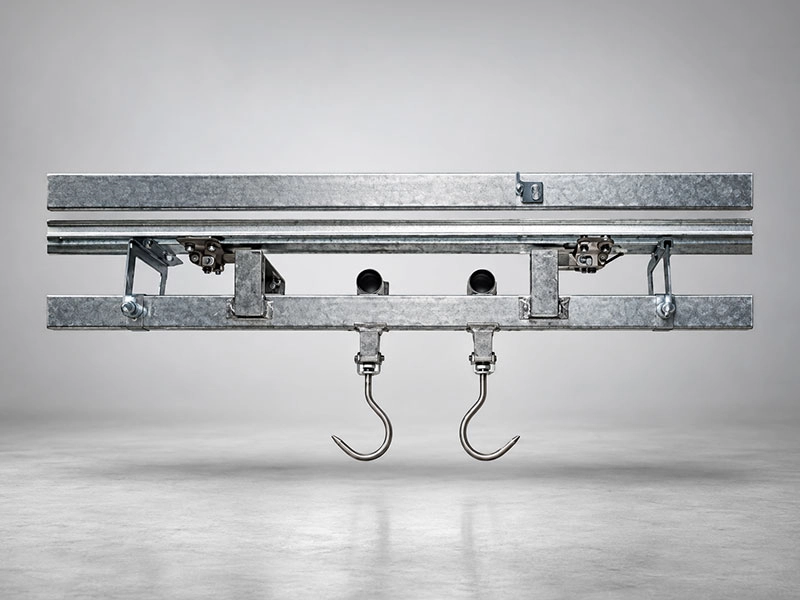
The MRS monorail scale weighs carcasses on the rail, without taking them down, as they reach the end of the processing line in abattoirs, slaughterhouses and meat processing plants. It is integrated into your existing monorail line, and its weighing section runs on two flat-beam load cells. The frame is made of stainless steel or hot-dip galvanised material, depending on conditions in the plant.
In the MRS, a short length of the carcass rail is separated from the rest of the line and turned into a weigh rail. This piece is not fixed directly to the supporting structure but hangs from it through two flat-beam load cells. When the trolley rolls onto the weigh rail, carcass, hook and trolley together load the two cells, each taking part of the weight; the indicator adds the two signals together and shows the result as a single figure.
Thanks to its flat body, a flat-beam load cell fits into the narrow gap between rail and support and senses the force from the hanging load directly. With two cells, the total load is measured wherever the trolley stops along the weigh rail. The carcass therefore does not need to stop exactly in the middle of the weighing section; as long as the trolley stays within it, the reading is correct.
A 24-bit converter in the indicator turns the faint signal from the load cells into a digital value. Even a carcass swinging gently on its hook is read in small, steady steps once the swing dies down.
Rather than calling for a new line, the MRS is built to join a monorail system that is already running. The weigh rail is made to the same section as the rail on your line, and the joints are kept level with the existing rail so the trolley does not catch as it enters or leaves. Installed at the end of the line, the last point before carcasses go to chilling, cutting or dispatch, it records the finished weight of every carcass in one place.
Two frame materials are available. In slaughter halls with frequent pressure washing and constant contact with blood and cleaning chemicals, stainless steel needs less maintenance over the long run. In drier or partly dry areas, where the supporting structure gets less wet, hot-dip galvanising is an economical solution that protects the steel against corrosion with a thick zinc layer. When deciding, look at how close the weighing point is to the wash-down area and which cleaning products the plant uses.
In overhead rail weighing, the load reaching the indicator is not just the carcass; the hook and trolley carrying it also bear on the load cells. The MRS indicator deducts this weight as tare. Tare can be taken automatically while an empty hook sits on the weigh rail, or keyed in by hand for a hook-and-trolley set of known weight.
A simple example: say the hook and trolley together weigh 5 kg. For a load reading 285 kg on the weigh rail, the carcass itself weighs 285 − 5 = 280 kg. Once tare is entered, this subtraction happens automatically at every weighing and the display shows 280 kg directly. If different types of hook are used on the line, the weight of each type should be established once and written down, and the correct tare selected when weighing; otherwise the difference between hooks goes straight into the carcass weight.
At switch-on, the indicator sets its zero point automatically. If fat or blood builds up on the weigh rail during the day, manual zeroing corrects the starting value again.
For the MRS you can choose a weight indicator with either an LCD or an LED display. Choose a bright LED display if the operator has to read the figure from a few metres away along the line, and an LCD where power consumption matters.
The indicator runs for about 100 hours on its built-in rechargeable battery. In a slaughterhouse working one 8-hour shift a day, for instance, that equals 100 ÷ 8 = 12.5 working days; even with 12-hour shifts in busy periods such as the run-up to the festival, it covers 100 ÷ 12 ≈ 8 working days without charging. When the line stands still, the indicator saves power and eventually switches off, so the battery is not wasted. Battery operation also reduces the need to run mains cables into a wet slaughter hall.
Weights can be sent over RS 232 to a computer, a printer or a label printer. The wireless communication option helps where cabling across the slaughter hall is difficult, or where data is to be collected on a computer in the office. The unit can be switched from kilograms to pounds when needed, which is handy for shipments to buyers who work in pounds.
A few checks in the first days after the MRS is fitted lay the groundwork for reliable weighing in the months ahead:
Carcasses are weighed on the rail at the end of the line without leaving the hook, so no extra handling or contact is needed.
The weigh rail is made to match the section of your working monorail system and fitted into the line.
The weigh rail is carried on two load cells, so the total load is measured wherever the trolley stops.
Choose stainless steel or hot-dip galvanised steel according to how intensively the area is washed.
The built-in rechargeable battery gives about 100 hours of operation away from the mains.
Results go to a computer or printer, or wirelessly to your recording system.
| LCD and LED indicator options |
| Suitable for industrial weighing applications |
| High precision 24 bit Delta-Sigma Analog / Digital converter |
| Automatic power saving and automatic shutdown |
| Zero tracking on opening, manual reset |
| Internal rechargeable battery (100 Hours) |
| Kg / Lb unit replacement and part counting |
| Manual tare, automatic tare and tare |
| RS 232 and wireless communication, printer and PC connection |
| Extensive service network, 2 years warranty |
Slaughterhouses
Slaughter Houses
Meat Processing PlantsThe weigh rail is supported at two points, with a flat-beam load cell at each. The indicator adds the two readings, so the total weight is measured correctly whether the trolley stops at the start or the end of the weigh rail.
Yes. The built-in battery runs for about 100 hours; on 8-hour shifts that is well over a week and a half of use. Charging it on your weekly maintenance day is a good habit to avoid surprises in busy periods.
If the weighing point is right in the wash-down area and chemical cleaning is frequent, stainless steel is the better fit. In a drier section, such as the entrance to the chiller, hot-dip galvanised steel is an economical and durable option.
Not when tare is used. Tare can be taken automatically with an empty hook on the weigh rail, or the hook-and-trolley weight can be keyed in by hand. If the line uses different hook types, the tare of each one has to be set separately.
Yes. Alongside the wired RS 232 connection there is a wireless communication option. In plants where running a cable from the slaughter hall to the office is difficult, the wireless link sends data straight to the recording system.
The MRS is most often used at the end of the processing line to capture each carcass’s final weight. As long as the rail section suits, it can also go elsewhere, for example at the chiller exit; the weighing point is chosen according to whether the weight is used for payment, tracking chilling loss or dispatch.
Quote requested forMRS Monorail Scale
Still with you after installation
Send repair, maintenance and calibration requests through the Technical Service page or by phone.