














KBH Small Livestock Scale
- Capacity
- 300 kg – 600 kg
- Dimensions
- 50×90 – 60×100 cm
Bagging machines for grain, fertiliser, pellets, coal and powders. 5–50 kg bags, ±50–200 g accuracy. Let us help you choose the right model.

M-DF1Double Gate Bagging Machine
M-DB1Double Belt Bagging Machine
M-SF1Single Gate Bagging Machine
M-SB1Single Belt Bagging Machine
M-SF2Economical Single Gate Bagging Machine
M-AF1Auger Bagging Machine
M-DB2-2LTwo-Station Double Belt Bagging Machine ProBBF big bag filling machine for powders and granules: 500–2000 kg bags, 15–30 bags an hour, fed by gravity, belt or auger.
All Big Bag Filling Machines modelsWeigh-based liquid filling machine for jerrycans, tins, pails and drums: two-stage fast and slow filling, net or gross mode, Ex-proof option.
All Liquid Filling Machines modelsTruck scales for surface or pit installation, with steel-reinforced concrete, I-beam or V-beam steel decks. 6–22 m long, 40–100 t capacity.

WB-X800FI-Beam Steel Platform Truck Scale
WB-X600V-Beam Bridge Type Truck Scale
WB-X800PI-Beam Steel Pit Type Truck Scale
WB-X400PSteel-Reinforced Pit Type Truck Scale
WB-X400FSteel-Reinforced Concrete Truck ScaleCheckweighers that weigh every pack in motion and reject under- and overweight packs: CW, and MCW for compact lines. Rejection, reporting, retrofit.
All Checkweighers modelsHeavy-duty floor scales: CP, TP, U-type pallet scale, MB modular, steel bar and marble scales. Four OIML R60 C4 load cells, sized to the load.
All Heavy Duty Scales modelsBS single load cell platform scale: 30 kg–1.5 t, double-chassis electronic construction and dual-range weighing for bench and packing use.
All Bench Scales modelsMonorail scales for abattoirs and meat plants: carcasses are weighed on the rail. Fitted to your existing line, stainless or galvanised.
All Monorail Scales modelsLivestock scales for cattle, sheep, goats and sacrifice shares: the 80 mm low-profile BBH, gated KBH and a 7-point share scale.
All Livestock Scales modelsBK belt weigher for weighing bulk material on the conveyor without stopping the line: 800–2000 mm belts, flows up to 6000 t/h.
All Belt Weighers modelsFarms, feedlots and grain businesses.
Weighbridge yards, warehouses and dispatch.
Packing, filling and end-of-line checking.
Bulk material and vehicle weighing.
Liquid and powder filling.
Vehicle and platform weighing.
Surface and pit-mounted weighbridges for trucks and tractors.
Cattle and small livestock; low platforms for the farm.
Floor scales, pallet scales and single-cell platform scales.
Continuous flow and totalised weight on the belt.
Bag, big bag and liquid filling; automatic weighing lines.
Weighs packed products in line and rejects under- and overweight.
The BBH cattle scale weighs cattle, heifers and steers one at a time inside a crate, on a platform that rises just 80 mm above the floor. Offered in 1500, 2000 and 3000 kg capacities, it is built for beef finishing units, dairy farms and veterinary practices. There is no pit to dig and no concrete ramp to pour: the scale simply goes on a level spot in the shed or in a passage the animals already walk through every day.
The system has three parts: a low steel platform resting on four load cells, a crate that holds the animal centrally on the platform, and an indicator that shows the weight. Once the animal is in and the gate is shut, its weight spreads across the four corners. Each load cell turns its share of the force into an electrical signal, and the indicator adds these signals together to give a single live weight.
The signal is digitised by a high-resolution 24-bit analogue-to-digital converter, which in practice means the scale can tell weights apart in small steps. When the animal settles for a moment, the operator presses the HOLD key; the figure freezes on the display and can still be read and logged after the animal has walked out. The person keeping records no longer has to catch a number on screen while the animal fidgets.
The BBH comes in three standard capacities, each with its own reading step:
Choosing capacity on an animal’s standing weight alone can mislead. An animal that rushes into the crate or jumps inside briefly puts more than its own weight onto the platform. Say the heaviest bull in your herd weighs 1100 kg: the 1500 kg model looks adequate on paper, but with the 2000 kg model the margin grows to 2000 − 1100 = 900 kg, so the load cells meet those sudden knocks with far more headroom. The platform is built to withstand overloading, yet leaving a margin in daily use helps the scale keep weighing accurately for years.
The standard BBH measures 100 × 200 × 180 cm, a crate in which a grown animal can walk in and stand comfortably but cannot turn round. If breed or age differences in your herd call for a shorter or longer crate, the platform and crate can be made to the size you need, and capacity can be set to order as well.
Because the platform is only 80 mm high, an animal steps onto it as if it were still walking on the floor rather than climbing a step. Even newly arrived stock seeing the scale for the first time tend to hesitate less. A few points help with placement:
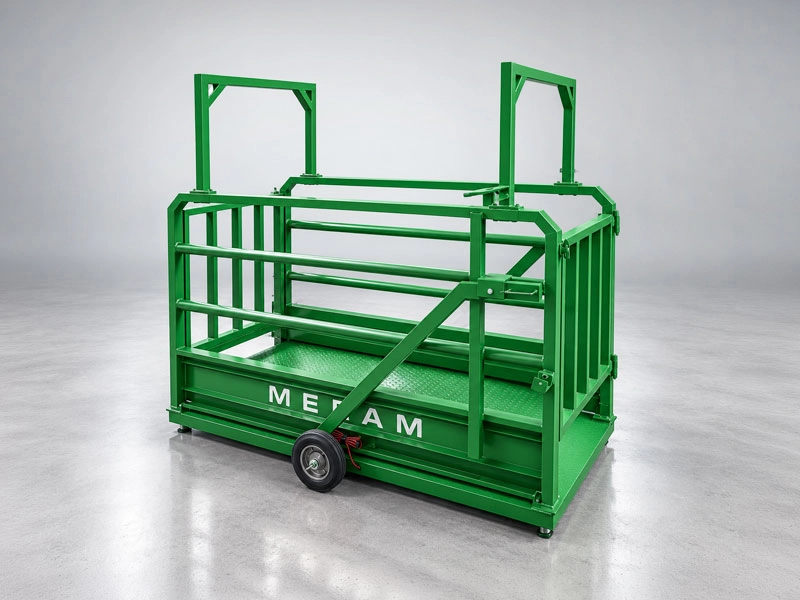
If you would rather use one scale across several pens than keep it in a single shed, the BBH can also be supplied as a mobile version on wheels.
The BBH can be paired with an LCD or LED indicator. Choose LED where the display must be read in bright outdoor light, and LCD where low power use comes first. Its internal rechargeable battery keeps the indicator running in paddocks with no mains supply, and in the shed it runs from a 220 V AC socket. Automatic switch-off saves the battery when the scale is idle.
Over RS 232, readings go straight to a computer, and they can be printed as tickets or labels. For farms that keep their records in herd software, this stops figures from getting mixed up when copied by hand. The unit of weight can be switched between kilograms and pounds if needed.
The HI-OK-LO check-weighing function on the indicator can serve as a drafting tool on a cattle farm. For example, if you enter 550 kg as the lower limit and 650 kg as the upper limit for animals ready for sale, those inside the band show “OK” and lighter ones show “LO”; thanks to the audible signal, the operator knows which animal goes to a separate pen without looking at the display.
Damp, manure and washing water make a livestock shed a tough place for electronics. The four load cells of the BBH are fully waterproof to IP68 and resist corrosion. The platform and crate are finished with electrostatic powder coating, which stands up to knocks and wet conditions much longer than ordinary paint.
For a long service life it is enough to scrape manure off the platform after weighing, clear bedding that collects underneath from time to time and touch up scratched paint promptly. At switch-on the indicator tracks zero automatically; if a little dirt stays on the platform, manual zeroing or the tare function removes that weight from the result.
Animals walk onto a platform only 80 mm above the floor without a ramp, and no pit is needed for installation.
Fully waterproof load cells at each corner resist corrosion in wet, dirty shed conditions.
The HOLD function freezes the reading taken when the animal settles, which makes recording easier.
The indicator runs on its built-in battery away from power and on 220 V AC in the shed; automatic switch-off saves energy.
An RS 232 link passes results to a PC, and weights can be printed as tickets or labels.
An optional wheeled frame lets you move the scale between sheds and pens.
| MODEL | CAPACITY | DIMENSIONS (cm) |
|---|---|---|
| BBH | 1500 Kg x 0.5 Kg | 100x200x180 cm |
| BBH | 2000 Kg x 1 Kg | 100x200x180 cm |
| BBH | 3000 Kg x 1 Kg | 100x200x180 cm |
 Veterinarians
 Livestock Breeding
The difference lies in the maximum load and the reading step. The 1500 kg model reads in 0.5 kg steps, while the 2000 and 3000 kg models read in 1 kg steps. Farms weighing mostly young stock tend to choose 1500 kg, mixed herds 2000 kg, and those handling big bulls and breeding stock 3000 kg.
Yes. The 0.5 kg step of the 1500 kg model in particular suits weekly growth checks on calves. Since the crate is sized for adult cattle, very small calves may turn round inside; holding them briefly at the entry speeds weighing up.
Yes. The standard size is 100 × 200 × 180 cm, but the scale can be built to other dimensions and capacities to suit the length of your animals and the width of the passage in your shed. When asking for a quotation, just tell us the rough length of your largest animal and the size of the space for the scale.
It can. Power comes from a rechargeable battery inside the indicator, topped up from a 220 V socket in the shed. Bringing the indicator indoors after weighing extends the life of both battery and display.
Results can be sent to a computer through the indicator’s RS 232 output, and a ticket or label printer can also be connected. If you tell us which software you use at the quotation stage, we plan the connection accordingly.
The standard BBH is meant for fixed use. If you plan to weigh in more than one shed, ask for the mobile version on wheels when ordering; the wheels make it much easier to move the scale from one shed to another.
Quote requested forBBH Livestock Scale
Still with you after installation
Send repair, maintenance and calibration requests through the Technical Service page or by phone.