Bagging machines for grain, fertiliser, pellets, coal and powders. 5–50 kg bags, ±50–200 g accuracy. Let us help you choose the right model.

M-DF1Double Gate Bagging Machine

M-DB1Double Belt Bagging Machine

M-SF1Single Gate Bagging Machine

M-SB1Single Belt Bagging Machine

M-SF2Economical Single Gate Bagging Machine

M-AF1Auger Bagging Machine

M-DB2-2LTwo-Station Double Belt Bagging Machine ProBBF big bag filling machine for powders and granules: 500–2000 kg bags, 15–30 bags an hour, fed by gravity, belt or auger.
All Big Bag Filling Machines modelsWeigh-based liquid filling machine for jerrycans, tins, pails and drums: two-stage fast and slow filling, net or gross mode, Ex-proof option.
All Liquid Filling Machines modelsTruck scales for surface or pit installation, with steel-reinforced concrete, I-beam or V-beam steel decks. 6–22 m long, 40–100 t capacity.

WB-X800FI-Beam Steel Platform Truck Scale

WB-X600V-Beam Bridge Type Truck Scale

WB-X800PI-Beam Steel Pit Type Truck Scale

WB-X400PSteel-Reinforced Pit Type Truck Scale

WB-X400FSteel-Reinforced Concrete Truck ScaleCheckweighers that weigh every pack in motion and reject under- and overweight packs: CW, and MCW for compact lines. Rejection, reporting, retrofit.
All Checkweighers modelsHeavy-duty floor scales: CP, TP, U-type pallet scale, MB modular, steel bar and marble scales. Four OIML R60 C4 load cells, sized to the load.
All Heavy Duty Scales modelsBS single load cell platform scale: 30 kg–1.5 t, double-chassis electronic construction and dual-range weighing for bench and packing use.
All Bench Scales modelsMonorail scales for abattoirs and meat plants: carcasses are weighed on the rail. Fitted to your existing line, stainless or galvanised.
All Monorail Scales modelsLivestock scales for cattle, sheep, goats and sacrifice shares: the 80 mm low-profile BBH, gated KBH and a 7-point share scale.
All Livestock Scales modelsBK belt weigher for weighing bulk material on the conveyor without stopping the line: 800–2000 mm belts, flows up to 6000 t/h.
All Belt Weighers modelsFarms, feedlots and grain businesses.
Weighbridge yards, warehouses and dispatch.
Packing, filling and end-of-line checking.
Bulk material and vehicle weighing.
Liquid and powder filling.
Vehicle and platform weighing.
Surface and pit-mounted weighbridges for trucks and tractors.
Cattle and small livestock; low platforms for the farm.
Floor scales, pallet scales and single-cell platform scales.
Continuous flow and totalised weight on the belt.
Bag, big bag and liquid filling; automatic weighing lines.
Weighs packed products in line and rejects under- and overweight.

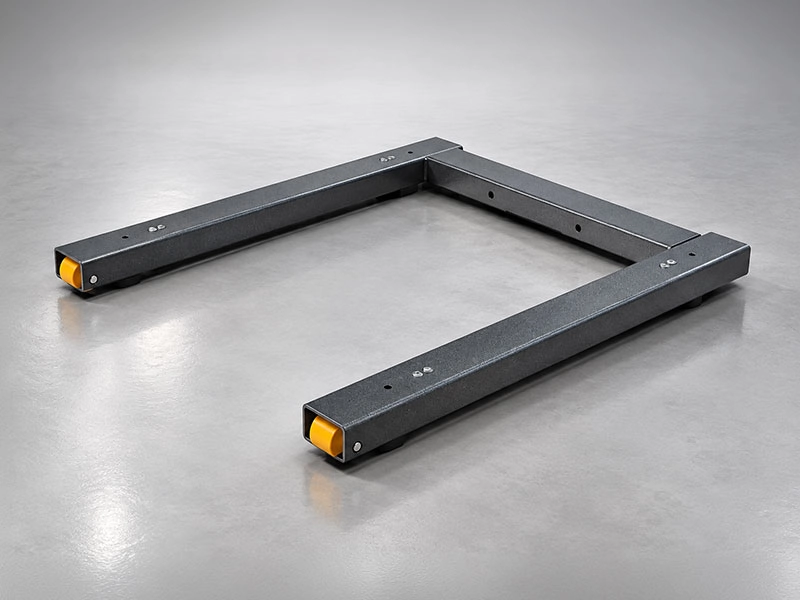
The U-type platform scale is a pallet scale whose open, U-shaped steel frame receives a pallet truck’s forks between its arms, letting the load be set down directly on them. With four OIML R60 C4 load cells, it is built in 600 kg, 1,500 kg and 3,000 kg capacities. Two wheels at the front and a handle at the back make it light enough for one person to move, which suits warehouses and dispatch areas where the weighing point changes often.
On a conventional floor scale, the pallet is either set down by forklift or pushed up a ramp on a pallet truck. With a U-type scale, both of those steps disappear. The operator pushes the loaded truck in through the open side of the U, and the forks end up between the two weighing arms. When the truck handle is lowered, the pallet comes off the forks and settles on the arms. From that moment the forks no longer carry the pallet, and the scale measures the pallet alone.
The only condition for a correct reading is that, once lowered, the forks do not touch the underside of the pallet or the arms of the scale. If the forks have not fully dropped, part of the load stays on the truck and the indicator reads short. So the first habit to teach operators is to make sure the truck is fully lowered before reading the value. When weighing is done, the handle is raised again, the pallet is picked up on the forks and the truck is drawn back out of the U.
The same scale can be used with a forklift too. The forklift sets the pallet on the two arms and withdraws its forks through the opening of the U. What matters here is lowering the pallet onto the arms gently rather than dropping it; a light, portable scale is designed for convenience, not for a work pattern of constant impact.
The most obvious difference of the U-type scale is that it is not permanently installed. The frame has two wheels on its front side and a carrying handle on the opposite side. Lifted by the handle, the scale rolls on its wheels like a wheelbarrow from one area to another. If goods-in happens at one door in the morning and another in the afternoon, or the end of a production line moves from time to time, the weighing point travels to where the work is.
The one thing to watch at the new spot is the floor. The surface under the four cells must be level and solid; never weigh at the foot of a sloping ramp or on a broken piece of concrete. A quick test with a known weight after each move confirms that the scale reads correctly in its new position.
The U-type scale is built in a single frame size of 1250 × 920 mm, with three capacity options. All are dual-range:
When setting capacity, count the weight of the empty pallet as well as the goods on it, because once the truck is lowered the scale carries the whole pallet. For example, a 1,380 kg load on a 30 kg wooden pallet puts 1,410 kg on the scale; that is close to the limit of the 600/1500 kg model, and for pallets that may be set down hard the 1500/3000 kg model leaves a more comfortable margin.
When checking the frame size, make sure the pallet truck forks enter the inner opening of the U easily and that the pallet does not touch the floor once lowered. Telling us the outer fork width of your pallet truck and your pallet dimensions lets us confirm the fit from the outset.
The standard U-type scale is finished with electrostatic oven-baked paint. In dry warehouses, courier operations and production areas this finish gives adequate protection. For food plants, cold stores or areas where the floor is washed often, there is also a version with the whole frame made of stainless steel. A stainless frame removes paint flaking and corrosion problems from the start on surfaces that meet wash water and cleaning chemicals.
With the forks inside the U, the truck sets the pallet down on the arms; no separate ramp or lifting is needed.
Two front wheels and a rear handle let one person take the scale wherever it is needed.
Four C4 class cells work under the U-shaped chassis, sharing the load wherever the pallet sits on the arms.
Each of the 600 kg, 1,500 kg and 3,000 kg models reads with a finer step in its lower range.
The standard frame is electrostatically painted; a fully stainless option is offered for wet and hygiene-sensitive areas.
The built-in rechargeable battery lets the scale work cable-free far from a socket; mains operation is also possible.
| MODEL | CAPACITY | DIMENSIONS (cm) |
|---|---|---|
| U+4LC | 300/600 kg x 0.1/0.2 Kg | 1250X920,100 |
| U+4LC | 600/1500 kg x 0.2/0.5 Kg | 1250X920,100 |
| U+4LC | 1500/3000 kg x 0.5/1 Kg | 1250X920,100 |
Production
Storage
Cargo
Transport
Quality Control
Commercial Weighing ApplicationsOnce the truck is fully lowered, the forks separate from the underside of the pallet and play no part in the weighing. If a fork has not dropped fully or is resting on an arm of the scale, the result comes out short. Checking that the handle has been lowered all the way before reading is enough.
The frame measures 1250 × 920 mm, and a 1,200 × 800 mm pallet sits with its long side along the arms. With other pallet sizes, what matters is that the pallet rests evenly on the arms and its edges do not touch the floor; send us your pallet size and we will check the fit.
On the TP the pallet truck climbs a ramp onto the platform and is weighed together with the pallet, so the truck weight is deducted as tare. On the U-type, the truck never goes onto the scale; the pallet rests on the arms and is weighed by itself. The U-type is also wheeled and portable, while the TP is a fixed station.
Usually not, as long as it is placed on a level, solid floor. Even so, it is worth placing a known weight on it once at the new location. For trade use, periodic inspection rules also apply separately.
If the scale will work in food production, in a cold store or in an area that is washed down often, the stainless version is more economical in the long run. For dry environments the standard electrostatically painted frame is enough.
Yes. Through its RS 232 output the indicator can send tickets and labels to a printer and pass records to a computer. A weight label stuck on the pallet removes the need to keep separate notes at dispatch.
Quote requested forU-Type Platform Scale
Still with you after installation
Send repair, maintenance and calibration requests through the Technical Service page or by phone.