Skip to content
Send an e-mailMessage us on WhatsAppLinkedInInstagramFacebookRequest a Quote
+90 332 226 07 76Message us on WhatsApp
Bagging Machines

M-SF2 Economical Single Gate Bagging Machine

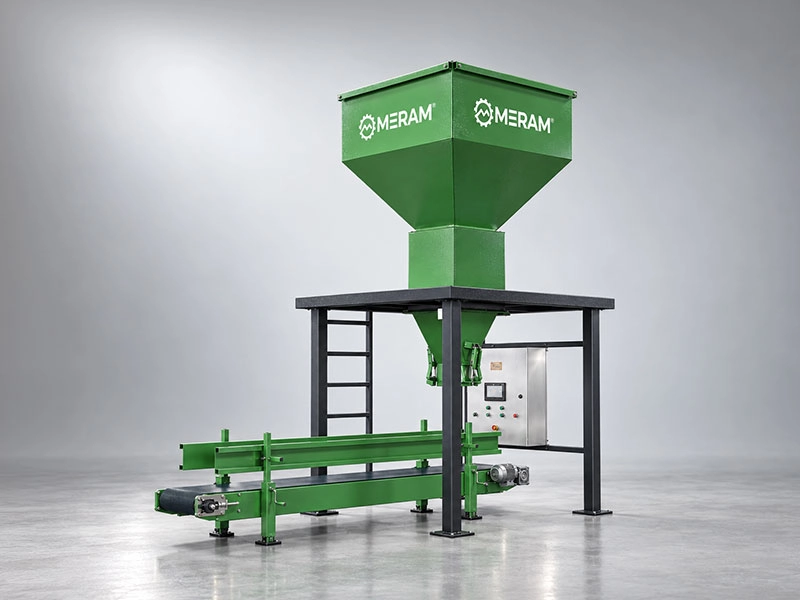
The M-SF2 economical single-gate bagging machine is the lightest and most compact member of the gate range, weighing grain and polymer-coated fertiliser into 25–50 kg bags. It turns out roughly 270 bags an hour from a 500-litre top hopper, and the whole machine weighs 750 kg. It is designed for businesses moving from hand filling to a weigh filler for the first time, whose daily volume stays moderate and who want an investment in proportion to their needs.

Weighing range
25 – 50 Kg
Output capacity
6 – 7 / 6 – 7 t/h
Weighing accuracy
± 50 – 150 gr

Who is it the right machine for?

The M-SF2 is aimed at businesses that bag not continuously all day but as orders come in, or in concentrated bursts at harvest. Typical users include grain traders working at village and district level, seed dealers, cooperative stores, small flour and feed mills and fertiliser dealers. In these businesses the real problem is often not speed but the fact that hand-filled bags all come out different, and the labour spent standing at the scale.

With hand filling, a worker fills the bag with a bucket or scoop, weighs it on a platform scale, then removes the excess or tops up the shortfall. That cycle can take minutes per bag. The M-SF2 takes over weighing and filling at the same time; the operator only puts the bag on and takes the full bag away.

How the M-SF2 differs from the M-SF1

Both models have one gate and one weigh hopper, and both handle the same product group. The difference lies in the load each machine is sized for:

  • Output: the M-SF2 works at a steady pace of about 270 bags per hour, which means 6–7 tonnes an hour with 25 kg bags. The M-SF1 can reach up to 440 bags per hour.
  • Hopper: the M-SF2 top hopper holds 500 litres, the M-SF1 hopper 1800 litres. The small hopper means the M-SF2 should sit close to the silo or feed conveyor and be fed continuously.
  • Weight and space: the 750 kg frame rests on a lighter support structure than the 1,400 kg M-SF1, which makes placement easier in stores with limited ceiling height.
  • Accuracy: weighing accuracy is ±50–200 g on the M-SF2 and ±50–150 g on the M-SF1. The 50 g difference means different things depending on bag weight, as explained below.

In short: if your daily target does not exceed 270 bags per hour and your buyer is not very strict about bag tolerance, the M-SF2 covers the need. When output or tolerance expectations go beyond that, moving to the M-SF1 makes more sense.

What does ±50–200 g mean in practice?

Relating accuracy to bag weight makes the figure meaningful. For example, a 200 g deviation on a 50 kg bag is four parts per thousand of the bag weight (200 / 50,000 = 0.004). On a 25 kg bag the same 200 g is eight parts per thousand. So the M-SF2 offers a tighter ratio on heavy bags and a looser one on light bags. Since much of the grain trade uses 50 kg bags, this ratio is acceptable to most buyers.

Which end of the range you land on is decided by the product itself. Products with round, even grains, such as polymer-coated fertiliser and clean grain, flow smoothly through the gate, and the result moves towards the lower end. With a high share of broken grains, straw or dust, flow becomes irregular and deviation grows. That is why, during commissioning, we weigh the first bags on a separate scale and set the fine filling point to suit your product. When the product batch changes, for example a new harvest or a different type of fertiliser, repeating the same check with a few bags keeps deviation near the lower limit.

Installation and daily operation

The M-SF2 runs on 400 VAC, 50–60 Hz three-phase power and 8–10 bar compressed air; the table assumes a 300-litre compressor for the air supply. If you already have a compressor, simply check that its capacity covers the movements of the gate and bag holder.

A 500-litre hopper holds roughly half a tonne of grain, which is a buffer of about ten 50 kg bags. If the feed stops for a moment, the machine runs empty within a few bags. The M-SF2 should therefore sit directly below a silo outlet or at the end of a continuously running screw conveyor or elevator. Because the hopper volume is defined as variable, a larger hopper can be discussed in the quotation if your feed is intermittent.

Day to day, the operator sets the bag weight on the touchscreen. When switching from grain to fertiliser, the hopper and weigh hopper must be emptied completely and swept out; fertiliser residue mixing into grain is unacceptable. Fertiliser tends to absorb moisture and stick to surfaces, so on fertiliser days the gate edges and the inside of the hopper need cleaning more often.

Key features

Compact 750 kg frame

The lightest machine in the gate range; easy to place in narrow, low-ceilinged stores.

270 bags per hour

A steady pace equal to 6–7 tonnes of product an hour; enough for medium daily volumes.

Grain and polymer fertiliser

Bags two different product groups that flow evenly under their own weight on the same machine.

500-litre top hopper

Sized to work under a silo or at the end of a continuous feed line; the volume can be changed if needed.

Target weight from 25 to 50 kg

Bag weight is changed on the panel; no mechanical adjustment or part change is needed.

An easy step into weigh filling

With one gate and one hopper the machine is quick to learn; a crew used to hand filling settles into a steady routine within a few shifts, and the labour spent at the scale drops noticeably.

Technical Specifications

Product type Grains, polymer fertiliser
Maximum weighing weight Variable
Weighing range options 25 – 50 Kg
Weighing accuracy ± 50 – 150 gr
Upper hopper capacity 500 litres (Variable)
Weighing system LoadSync™ TouchCommand™ Display
Output capacity 6 – 7 / 6 – 7 t/h
Bagging rate 270 – 270 bags / hour
System pressure (300lt. compressor) 8-10 Bar
Power supply (VAC) (±%5-10%) 400 VAC / 50-60Hz
Weight 750 Kg

Applications

  • Food and Chemical Production

Frequently asked questions

What makes the M-SF2 “economical”?

The machine is built around a smaller hopper, a lighter frame and a steady output of 270 bags per hour. A medium-sized business can move to weigh filling without paying for capacity it will not use.

Can the M-SF2 bag polymer fertiliser?

Yes, the machine is intended for grain and polymer fertiliser. If you will bag fertiliser and grain one after another on the same machine, emptying and cleaning the hopper and weigh hopper at each changeover must become part of your routine.

How many people are needed after switching from hand filling?

In most businesses a single operator puts the bag on and takes the full bag off. Sewing and stacking may need another person; that depends on whether full bags are carried by hand or by conveyor.

What can I do if my output grows later?

Once demand rises above 270 bags an hour, we look at the single-gate M-SF1 or the double-hopper M-DF1. The existing M-SF2 can stay in use on a second line, for example as a filling point reserved for fertiliser.

Will the small hopper leave the machine idle?

Not if feeding is continuous. 500 litres is a buffer of about ten 50 kg bags; if the silo outlet blocks or the feed conveyor stops, the machine soon waits. If your feed is intermittent, a larger hopper can be discussed.

Does it run on single-phase power?

No. According to the technical table the machine must be connected to three-phase 400 VAC at 50–60 Hz. If your site only has single phase, please mention it at the quotation stage.

Request a Quote

Quote requested forM-SF2 / Economical Single Gate Bagging Machine

Bag weight (optional)

Your details are used only to reply to your request. Privacy Notice

Still with you after installation

Send repair, maintenance and calibration requests through the Technical Service page or by phone.

Technical service request

Related Products

Bagging Machines