Bagging machines for grain, fertiliser, pellets, coal and powders. 5–50 kg bags, ±50–200 g accuracy. Let us help you choose the right model.

M-DF1Double Gate Bagging Machine

M-DB1Double Belt Bagging Machine

M-SF1Single Gate Bagging Machine

M-SB1Single Belt Bagging Machine

M-SF2Economical Single Gate Bagging Machine

M-AF1Auger Bagging Machine

M-DB2-2LTwo-Station Double Belt Bagging Machine ProBBF big bag filling machine for powders and granules: 500–2000 kg bags, 15–30 bags an hour, fed by gravity, belt or auger.
All Big Bag Filling Machines modelsWeigh-based liquid filling machine for jerrycans, tins, pails and drums: two-stage fast and slow filling, net or gross mode, Ex-proof option.
All Liquid Filling Machines modelsTruck scales for surface or pit installation, with steel-reinforced concrete, I-beam or V-beam steel decks. 6–22 m long, 40–100 t capacity.

WB-X800FI-Beam Steel Platform Truck Scale

WB-X600V-Beam Bridge Type Truck Scale

WB-X800PI-Beam Steel Pit Type Truck Scale

WB-X400PSteel-Reinforced Pit Type Truck Scale

WB-X400FSteel-Reinforced Concrete Truck ScaleCheckweighers that weigh every pack in motion and reject under- and overweight packs: CW, and MCW for compact lines. Rejection, reporting, retrofit.
All Checkweighers modelsHeavy-duty floor scales: CP, TP, U-type pallet scale, MB modular, steel bar and marble scales. Four OIML R60 C4 load cells, sized to the load.
All Heavy Duty Scales modelsBS single load cell platform scale: 30 kg–1.5 t, double-chassis electronic construction and dual-range weighing for bench and packing use.
All Bench Scales modelsMonorail scales for abattoirs and meat plants: carcasses are weighed on the rail. Fitted to your existing line, stainless or galvanised.
All Monorail Scales modelsLivestock scales for cattle, sheep, goats and sacrifice shares: the 80 mm low-profile BBH, gated KBH and a 7-point share scale.
All Livestock Scales modelsBK belt weigher for weighing bulk material on the conveyor without stopping the line: 800–2000 mm belts, flows up to 6000 t/h.
All Belt Weighers modelsFarms, feedlots and grain businesses.
Weighbridge yards, warehouses and dispatch.
Packing, filling and end-of-line checking.
Bulk material and vehicle weighing.
Liquid and powder filling.
Vehicle and platform weighing.
Surface and pit-mounted weighbridges for trucks and tractors.
Cattle and small livestock; low platforms for the farm.
Floor scales, pallet scales and single-cell platform scales.
Continuous flow and totalised weight on the belt.
Bag, big bag and liquid filling; automatic weighing lines.
Weighs packed products in line and rejects under- and overweight.

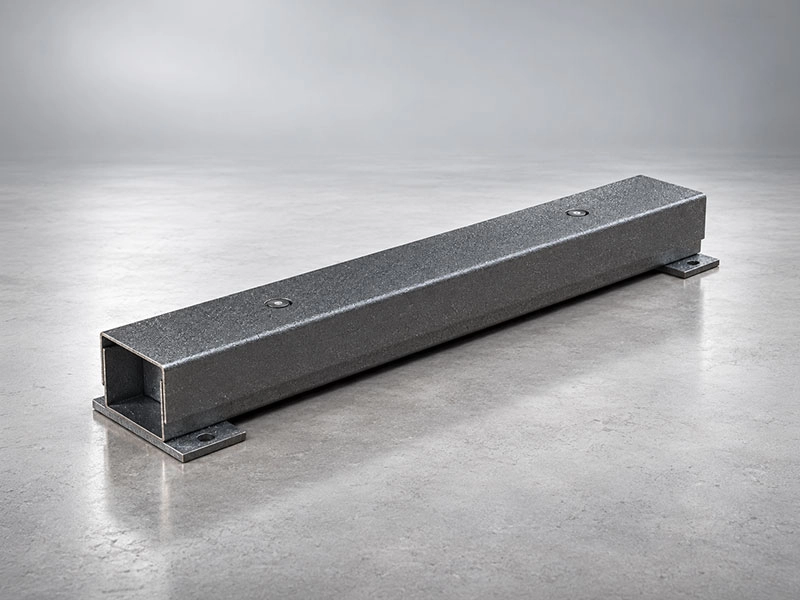
The MB modular scale is a multi-purpose weighing system made of two independent weighing modules, with the user setting the distance between them to suit the load. The U-shaped modules carry four OIML R60 C4 load cells in total, and each module has its own carrying handle. It is designed for machine frames, long crates, tanks and loads whose length changes from one job to the next, none of which fit a fixed-size platform.
On a conventional floor scale the platform dictates the size: if the load is larger than the platform it either overhangs or cannot be weighed at all. The MB removes that limit, because there is no platform in the middle. The load sits like a bridge across two weighing modules placed parallel on the floor. Each module carries its own side’s share of the load; the signals from all four cells are combined at a single indicator and the display shows the full weight.
The gap between the modules can be reset for every use according to the length of the item being weighed. For a short crate the modules are moved closer together; for a long machine chassis they are spread apart. The same scale can therefore weigh a mould one day and a control cabinet or a tank the next. The user configures the weighing system around whatever load the business has in hand. That flexibility means one system can cover many jobs instead of buying several scales of different sizes, a clear gain for job-shop workshops that turn out work of a different size every month.
Within the heavy-duty group, the MB is the model dedicated to jobs without a fixed size. Compared with its siblings, it sits as follows:
For the MB to work properly, the load must be able to bridge the two modules with its own body. A machine chassis, a crate or the skids of a tank meet this condition easily. Piles of sacks or loosely strapped long sections, on the other hand, sag in the middle; for loads like these either a base frame is used or a different model is chosen.
Using the MB involves no civil works; the modules are simply placed on a level, solid floor. For a correct result, keep these points in mind:
The load’s centre of gravity does not have to be exactly midway between the two modules. On a machine chassis with its motor at one end, for example, the larger share of the weight lands on the module nearer that end; because the indicator reads the sum of both modules, the result is still correct. What matters is that the share on any single module stays within what that module can carry. For unbalanced loads, telling us the weight distribution at the quotation stage ensures the right capacity is chosen.
The carrying handles on each module mean the MB can be lifted away and stored to one side when the job is over. Thanks to its light construction, the modules can be taken from one workshop to another, or even to a customer’s site for dispatch. For manufacturers who only weigh large parts on shipping day, this is a far more efficient answer than a fixed platform that takes up floor space permanently.
Standard MB modules are finished with electrostatic oven-baked paint. If they will be used in wet areas, food or chemical plants or wash-down zones, the version with modules made entirely of stainless steel can be chosen.
The modules are placed separately, and the distance between them is reset to suit the length of each load.
Each module is made of steel in a U shape and transfers the load evenly to the cells beneath it.
The signals from the four cells across both modules are combined at one indicator, and the whole load is read as a single value.
Handles on each module let the scale be set up, lifted away and moved to another area.
Alongside the standard electrostatically painted modules, a fully stainless version is available for wet and hygienic areas.
It reads with a finer step in the lower range; the weight of a base frame or skid is removed by keying it in or taking a tare.
| MODEL | KAPASİTE | ÖLÇÜLER(cm) |
|---|---|---|
| MB | M30000 kg x 10Kg | 200x300x50cm (l-w-h) |
Production
Storage
Cargo
Transport
Quality Control
Commercial Weighing ApplicationsThe limit is set by the load’s ability to bridge the two modules without bending. A rigid chassis or crate spans a wide gap with ease; with flexible loads the gap is kept short or the load is put on a base frame. Just tell us the longest and shortest loads you will weigh.
No. Because the indicator reads the sum of all four cells, a load that is heavier at one end does not change the total. The point to watch is that the heavy side does not exceed the limit of the module carrying it.
They can; a pallet set across both modules gives a correct reading. But if most of the work is standard pallets, a CP, TP or U-type scale gives a faster flow than lining each load up with two modules.
Yes. The load is lowered onto both modules by crane and weighed once the sling is slack. If the reading is taken before the sling is fully released, the result comes out short, because part of the load is still hanging from the crane.
As long as the modules are placed parallel on a level, solid floor, recalibration is not needed for each set-up. A brief check with a known weight in a new layout is still recommended.
Dual-range weighing, manual and automatic tare, piece counting, switching between kilograms, pounds and litres, HI-OK-LO checkweighing, and tickets, labels and a computer link over RS 232 are all available. Power comes from a built-in rechargeable battery or 220 V mains.
Quote requested forMB Modular Scale
Still with you after installation
Send repair, maintenance and calibration requests through the Technical Service page or by phone.