














M-DB1 Double Belt Bagging Machine
- Weighing range
- 25 – 50 Kg
- Output capacity
- 19 – 22 / 17 – 19 t/h
Bagging machines for grain, fertiliser, pellets, coal and powders. 5–50 kg bags, ±50–200 g accuracy. Let us help you choose the right model.

M-DF1Double Gate Bagging Machine
M-DB1Double Belt Bagging Machine
M-SF1Single Gate Bagging Machine
M-SB1Single Belt Bagging Machine
M-SF2Economical Single Gate Bagging Machine
M-AF1Auger Bagging Machine
M-DB2-2LTwo-Station Double Belt Bagging Machine ProBBF big bag filling machine for powders and granules: 500–2000 kg bags, 15–30 bags an hour, fed by gravity, belt or auger.
All Big Bag Filling Machines modelsWeigh-based liquid filling machine for jerrycans, tins, pails and drums: two-stage fast and slow filling, net or gross mode, Ex-proof option.
All Liquid Filling Machines modelsTruck scales for surface or pit installation, with steel-reinforced concrete, I-beam or V-beam steel decks. 6–22 m long, 40–100 t capacity.

WB-X800FI-Beam Steel Platform Truck Scale
WB-X600V-Beam Bridge Type Truck Scale
WB-X800PI-Beam Steel Pit Type Truck Scale
WB-X400PSteel-Reinforced Pit Type Truck Scale
WB-X400FSteel-Reinforced Concrete Truck ScaleCheckweighers that weigh every pack in motion and reject under- and overweight packs: CW, and MCW for compact lines. Rejection, reporting, retrofit.
All Checkweighers modelsHeavy-duty floor scales: CP, TP, U-type pallet scale, MB modular, steel bar and marble scales. Four OIML R60 C4 load cells, sized to the load.
All Heavy Duty Scales modelsBS single load cell platform scale: 30 kg–1.5 t, double-chassis electronic construction and dual-range weighing for bench and packing use.
All Bench Scales modelsMonorail scales for abattoirs and meat plants: carcasses are weighed on the rail. Fitted to your existing line, stainless or galvanised.
All Monorail Scales modelsLivestock scales for cattle, sheep, goats and sacrifice shares: the 80 mm low-profile BBH, gated KBH and a 7-point share scale.
All Livestock Scales modelsBK belt weigher for weighing bulk material on the conveyor without stopping the line: 800–2000 mm belts, flows up to 6000 t/h.
All Belt Weighers modelsFarms, feedlots and grain businesses.
Weighbridge yards, warehouses and dispatch.
Packing, filling and end-of-line checking.
Bulk material and vehicle weighing.
Liquid and powder filling.
Vehicle and platform weighing.
Surface and pit-mounted weighbridges for trucks and tractors.
Cattle and small livestock; low platforms for the farm.
Floor scales, pallet scales and single-cell platform scales.
Continuous flow and totalised weight on the belt.
Bag, big bag and liquid filling; automatic weighing lines.
Weighs packed products in line and rejects under- and overweight.
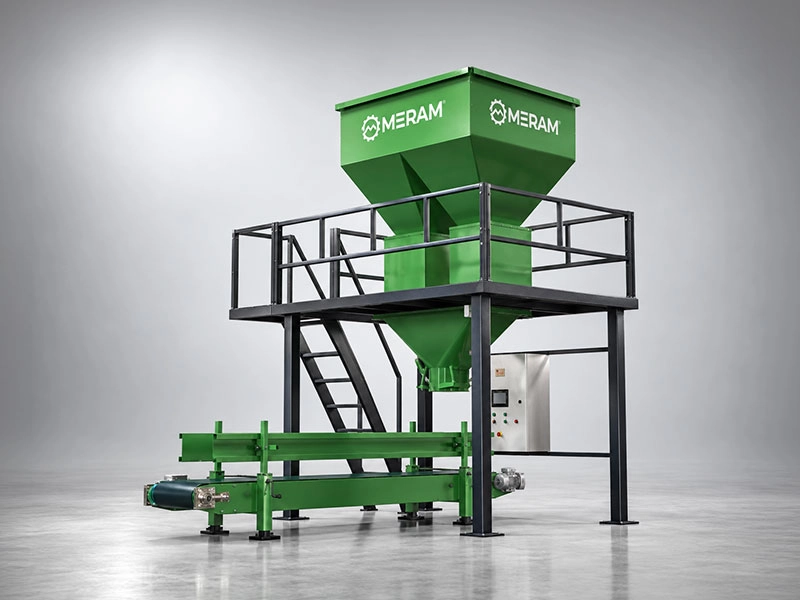
The M-DF1 double-gate bagging machine is the highest-output model in the gate range, weighing grain alternately in two separate weigh hoppers and filling it into 25–50 kg bags. It handles 400–750 bags per hour, roughly 17–22 tonnes of product, and keeps its ±50–150 g accuracy at that pace. It is designed for large grain stores, flour mills and grain exporters that must bag and dispatch thousands of tonnes in a short time at harvest.
In a single-hopper machine, every bag goes through three steps in turn: the hopper fills and is weighed, the product is discharged into the bag, and the hopper closes and starts filling again. Weighing stops during discharge. On the M-DF1 two hoppers work side by side. While the first discharges into a bag, the second weighs the product for the next bag; when the turn changes, so do their roles. Discharge time is thus hidden inside weighing time, and the filling spout hardly ever waits.
The second benefit concerns accuracy. On a fast single-hopper machine, the way to raise output is to shorten the fine filling phase, which increases deviation. With two hoppers, each one has more time for its own cycle. Because the pace can rise without cutting the fine fill short, the tolerance stays in the same ±50–150 g range as the single-gate M-SF1, even at 750 bags per hour.
The hourly target decides. For a business staying below 440 bags per hour, the M-DF1 is larger than needed; the single-gate M-SF1 bags the same product with less space and a lighter structure. The M-DF1 makes sense at the point where the daily target can no longer be met with one hopper.
If your product is pellets, coal or pumice rather than grain, the belt-fed M-DB1 in the same output class is preferred; a gate is hard on coarse and fragile grains.
Machine speed only helps as long as the rest of the line keeps up. For example, 720 bags an hour means one bag every 5 seconds (3,600 / 720 = 5). At that pace, putting the bag on the spout, closing the bag holder and dropping the full bag onto the conveyor must all fit into 5 seconds. The sewing machine and conveyor must also run at the same speed; otherwise bags pile up at the spout and the machine runs below its own capacity.
That is why our M-DF1 quotations cover not only the machine but also the bag placing point and the sewing and stacking arrangement. In practice, at this speed, placing bags and guiding full bags should be given to different people, and empty bags should be kept ready right next to the operator.
The M-DF1 weighs about 2,300 kg and carries a 3000-litre hopper on top. For example, if wheat is taken at roughly 0.75–0.8 kg per litre, a full hopper holds more than 2 tonnes of product. The steel structure or concrete floor the machine stands on must be planned to carry this total load safely. As the hopper volume is variable, a different size can be discussed to match the flow rate of your silo outlet.
Power supply is 400 VAC, 50–60 Hz three-phase. Two gates and the bag holder are moved by compressed air, so 8–10 bar is required; the technical table assumes a 300-litre compressor. Because the number of pneumatic movements rises at high speed, the cross-section of the air line and the compressor’s suitability for continuous duty deserve extra attention.
On a two-hopper machine it is important that the two weighing paths do not give different results. If product builds up inside one hopper or a gate edge wears, bags start coming out alternately light and heavy. An easy way to spot this is to weigh several consecutive bags on a separate scale and compare odd- and even-numbered bags. If the gap grows, the hopper concerned is cleaned and recalibrated from the touchscreen panel. Making this check part of a weekly routine stops an unnoticed drift from spreading across hundreds of bags, especially during the harvest rush.
One hopper discharges while the other weighs; the spout never waits for product.
The highest output in the gate range; handles around 17–22 t/h of grain.
Pace rises without shortening the fine fill, so tolerance matches the single-gate model.
A wide buffer against fast consumption; short fluctuations at the silo outlet do not stop filling.
During intake and dispatch peaks that last only a few weeks of the year, it markedly shortens bagging work that would take a single-hopper machine days; the store empties sooner and trucks wait less.
Target weight and calibration are managed on the touchscreen; changing bag weight needs no mechanical intervention.
| Touch panel, making prescriptions |
| 3 load cells |
| Automatic tare and weighing error correction process |
| Total weight and total number of bags monitoring |
| Ability to buy any number of bags |
| Waiting and warning if the weight is out of acceptable tolerance |
| Turkish and English menu warning messages |
| Electricity requirement 220 V. 50Hz. AC, air consumption 700lt / min |
| Capacity: 15 – 30 Ton / h |
 Food and Chemical Production
Divide your daily target by net running hours. If the result is below 440 bags per hour, the M-SF1 is enough; if it is above, or if many bags are needed in a short window such as harvest, choose the M-DF1.
No, the upper limit applies to light bags and evenly flowing product. With 25 kg bags you approach the top of the range; with 50 kg bags the lower end, around 400 bags per hour. With broken or dusty batches the fine fill takes longer, so the pace drops somewhat.
At this pace we recommend that placing bags and guiding full bags to the sewing machine are done by separate people. If stacking is manual, extra staff are needed; the conveyor and palletising layout decide the number.
The machine is designed for grain. For pellets, coal and pumice, the belt-fed M-DB1 in the same output class is gentler on the product than a gate and reduces the risk of jamming.
First the hopper interior and gate edges are cleaned, then the hopper concerned is recalibrated from the panel. Weighing consecutive bags on a separate scale is a practical way to catch the difference early.
Bag length, conveyor height and the sewing machine are considered together under the spout. We set these dimensions with you at the quotation stage, based on your bag type and building height.
Quote requested forM-DF1 / Double Gate Bagging Machine
Still with you after installation
Send repair, maintenance and calibration requests through the Technical Service page or by phone.