Skip to content
Send an e-mailMessage us on WhatsAppLinkedInInstagramFacebookRequest a Quote
+90 332 226 07 76Message us on WhatsApp
Livestock Scales

KBH Small Livestock Scale

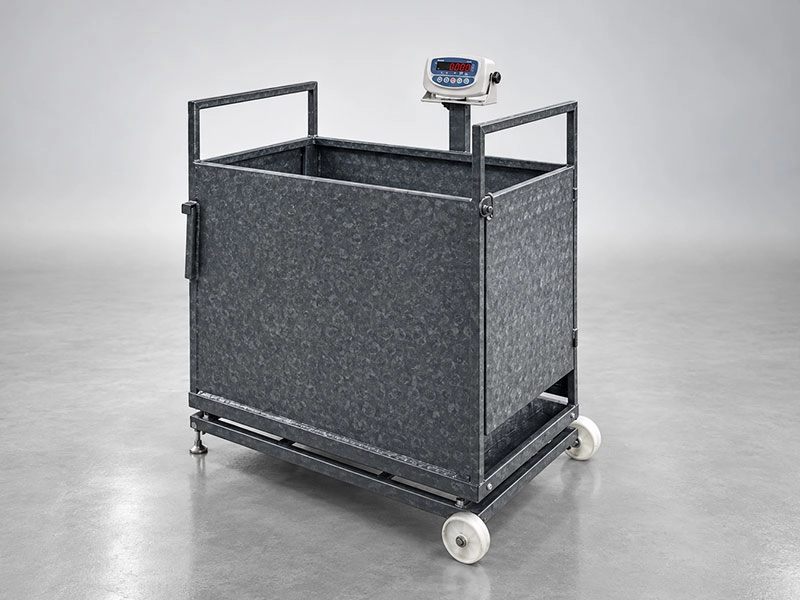
The KBH sheep and goat scale weighs sheep, goats, lambs and kids one by one in a wheeled crate with enclosed sides and an entry and exit gate at either end. With a capacity of 300/600 kg and reading steps of 0.1/0.2 kg, it suits flock owners who track growth, finishing units and veterinary practices. It comes in two builds: the KBH 1 on a single load cell and the KBH 4 on four load cells.

Capacity
300 kg – 600 kg
Dimensions
50×90 – 60×100 cm
Options
2 models

Why a gated crate?

The hardest part of weighing sheep and goats is separating one animal from the flock and keeping it still for a few seconds. On an open platform, a ewe or goat either steps straight off or pulls the next animal along behind it. On the KBH both side walls are closed, so the animal can only face forwards or backwards. It enters through the gate at one end, the gate shuts behind it, it is weighed and it leaves through the gate at the far end.

Placed at a pen exit or in a race, this layout turns the flock into a one-way flow. As one animal leaves, the next is ready to step in, and the operator only has to open and close the gates and record the weight instead of handling each animal. Compared with the old habit of lifting animals onto a scale, it is easier on the farmer’s back and far less stressful for the stock.

KBH 1 or KBH 4?

Both models share the same capacity and size range; the difference is the load cell layout under the platform.

  • KBH 1: the platform sits on a single central load cell. The design is simple, the scale stays lighter and it is practical where it will be moved often.
  • KBH 4: the platform is carried by load cells at its four corners. Even when an animal leans against one end or pushes against a gate, the load is shared between four points, which makes it the choice for farms weighing many animals a day, with stock that keeps shifting on the platform.

Two questions settle the choice: will the scale go to a different pen every day, or stay mostly in one place? And how many animals will pass through on a weighing day? For frequent moves and moderate numbers, choose the KBH 1; for heavy use at a fixed race, the KBH 4 is the better fit.

Capacity, reading step and size

The technical table gives capacity as 300/600 kg and the reading step as 0.1/0.2 kg: at 300 kg capacity the scale reads in 0.1 kg steps, and at 600 kg in 0.2 kg steps. Even 300 kg leaves ample margin for a mature ram or billy goat; what really counts is being able to see small differences in light animals such as lambs and kids.

A simple sum shows why this matters. Suppose a lamb weighs 18.4 kg at the first weighing and 24.7 kg thirty days later: its daily live weight gain is (24.7 − 18.4) ÷ 30 = 0.21 kg. On a scale reading in whole kilograms the same lamb would show as 18 and 25 kg, and the figure would drift to 0.23 kg; across a flock, that error can give a false picture of which lambs are falling behind. A 0.1 kg step makes it easier to capture real growth even when weighings are close together.

Platform sizes range from 50 × 90 cm to 60 × 100 cm. The narrower size stops lambs and kids turning round inside, while the wider one lets large rams and billies walk in comfortably. If your flock needs a size outside this range, the scale can be made to the dimensions and capacity you require.

Moving the scale and using it in the field

Wheels on both sides of the KBH let one person push it from place to place. For farms that weigh in the fold in winter, out at pasture in spring or in front of the barn at shearing time, the same scale can serve at different spots throughout the year. The body is electrostatically powder-coated, protecting it from damp pen floors, manure and rain.

Thanks to its built-in rechargeable battery, the indicator works out at pasture with no power supply; back at the fold it plugs into 220 V AC to charge and run. When left idle, the indicator protects its power and turns itself off, so the battery does not drain over a long weighing day. Before you start, pull the scale onto firm, level ground and make sure the platform feet, not the wheels, are carrying the load; accurate results depend on it.

How the indicator helps with records and sorting

Once the animal settles between the gates, the HOLD key fixes the reading on the display, so the operator does not lose the weight while reading the ear tag. Results can be sent to a computer over RS 232 or printed as tickets or labels. When selecting breeding stock or sorting before sale, the HI-OK-LO check-weighing function helps: enter a band of 35–45 kg for sale lambs, for instance, and lambs within it are flagged with an audible signal and sent to a separate pen.

Very young lambs and kids may be easier to weigh in a basket or crate than in the gated section. Put the empty crate on the platform and tare it; the display then shows the animal’s weight alone. Tare can also be keyed in by hand: if you use the same crate every day, note its weight once and there is no need to tare it at every weighing.

Key features

Enclosed sides, gates at both ends

Animals enter through one gate and leave through the other, so the flock is weighed in single file without handling.

Wheels for moving

Wheels on both sides let the scale move easily between fold, pasture and barn.

One or four load cells

The KBH 1 offers a simple, light build on one load cell; the KBH 4 uses four load cells for heavy daily use.

0.1 kg reading step

Reading in 0.1 kg steps at 300 kg capacity lets you follow lamb and kid growth through small differences.

Battery-powered indicator

A built-in rechargeable battery allows weighing away from power; LCD or LED displays are available.

Tare and HI-OK-LO

Crate weight can be tared off, and upper and lower limits sort animals into groups with an audible signal.

Technical Specifications

MODEL  CAPACITY DIMENSIONS (cm)
KBH 1 300/600 kg x 0.1/0.2 Kg 50×90 – 60×100 cm
KBH 4 300/600 kg x 0.1/0.2 Kg 50×90 – 60×100 cm

Applications

  • Veterinarians
  • Livestock Breeding

Frequently asked questions

KBH 1 or KBH 4: which one suits my flock?

Capacity and size range are the same; the number of load cells differs. The KBH 1 uses one load cell, so it is simpler and lighter and suits frequent moves. The KBH 4, on four load cells, is less affected by where the animal stands and comes into its own at fixed races where many animals are weighed.

Should I choose 50 × 90 cm or 60 × 100 cm?

If your flock is mostly lambs and kids, the narrow size speeds weighing because animals cannot turn round inside. For mixed flocks that include big rams and billies, 60 × 100 cm gives easier entry. If you are unsure, measure the length of your largest animal and send it to us.

Can I weigh newborn lambs on the KBH?

Yes. Place the lamb on the platform in a crate or basket and tare off the crate weight. At 300 kg capacity, the 0.1 kg step gives enough detail to track birth weight and gains over the first weeks.

Do I need 600 kg capacity for sheep?

For most flocks, 300 kg capacity with 0.1 kg steps is enough. The 600 kg option leaves a wider margin where the scale often takes hard entries from heavy rams or will also be used for loads other than small ruminants; the trade-off is a reading step of 0.2 kg.

Can I take the scale out to pasture?

You can. The wheels make it easy to move and the built-in battery lets it work without mains power. Before weighing, move the scale onto level, firm ground so that the results stay consistent.

Can weighing records be matched to ear tag numbers?

The indicator’s RS 232 output sends results to a computer, where each weight can be stored against the ear tag number. With a ticket or label printer connected, you can also get a printed weighing slip for every animal.

Request a Quote

Quote requested forKBH Small Livestock Scale

Your details are used only to reply to your request. Privacy Notice

Still with you after installation

Send repair, maintenance and calibration requests through the Technical Service page or by phone.

Technical service request

Related Products

Livestock Scales