Bagging machines for grain, fertiliser, pellets, coal and powders. 5–50 kg bags, ±50–200 g accuracy. Let us help you choose the right model.

M-DF1Double Gate Bagging Machine

M-DB1Double Belt Bagging Machine

M-SF1Single Gate Bagging Machine

M-SB1Single Belt Bagging Machine

M-SF2Economical Single Gate Bagging Machine

M-AF1Auger Bagging Machine

M-DB2-2LTwo-Station Double Belt Bagging Machine ProBBF big bag filling machine for powders and granules: 500–2000 kg bags, 15–30 bags an hour, fed by gravity, belt or auger.
All Big Bag Filling Machines modelsWeigh-based liquid filling machine for jerrycans, tins, pails and drums: two-stage fast and slow filling, net or gross mode, Ex-proof option.
All Liquid Filling Machines modelsTruck scales for surface or pit installation, with steel-reinforced concrete, I-beam or V-beam steel decks. 6–22 m long, 40–100 t capacity.

WB-X800FI-Beam Steel Platform Truck Scale

WB-X600V-Beam Bridge Type Truck Scale

WB-X800PI-Beam Steel Pit Type Truck Scale

WB-X400PSteel-Reinforced Pit Type Truck Scale

WB-X400FSteel-Reinforced Concrete Truck ScaleCheckweighers that weigh every pack in motion and reject under- and overweight packs: CW, and MCW for compact lines. Rejection, reporting, retrofit.
All Checkweighers modelsHeavy-duty floor scales: CP, TP, U-type pallet scale, MB modular, steel bar and marble scales. Four OIML R60 C4 load cells, sized to the load.
All Heavy Duty Scales modelsBS single load cell platform scale: 30 kg–1.5 t, double-chassis electronic construction and dual-range weighing for bench and packing use.
All Bench Scales modelsMonorail scales for abattoirs and meat plants: carcasses are weighed on the rail. Fitted to your existing line, stainless or galvanised.
All Monorail Scales modelsLivestock scales for cattle, sheep, goats and sacrifice shares: the 80 mm low-profile BBH, gated KBH and a 7-point share scale.
All Livestock Scales modelsBK belt weigher for weighing bulk material on the conveyor without stopping the line: 800–2000 mm belts, flows up to 6000 t/h.
All Belt Weighers modelsFarms, feedlots and grain businesses.
Weighbridge yards, warehouses and dispatch.
Packing, filling and end-of-line checking.
Bulk material and vehicle weighing.
Liquid and powder filling.
Vehicle and platform weighing.
Surface and pit-mounted weighbridges for trucks and tractors.
Cattle and small livestock; low platforms for the farm.
Floor scales, pallet scales and single-cell platform scales.
Continuous flow and totalised weight on the belt.
Bag, big bag and liquid filling; automatic weighing lines.
Weighs packed products in line and rejects under- and overweight.

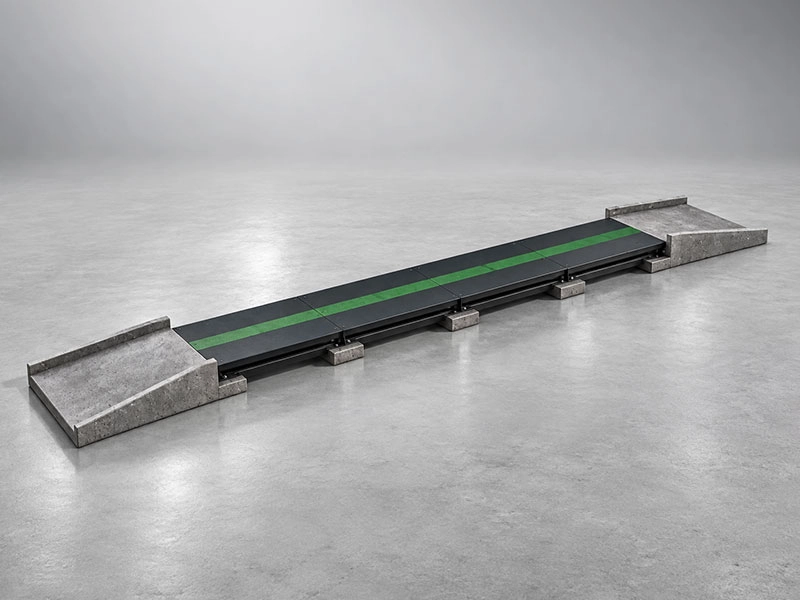
WB-X200 is a compact, surface-mounted vehicle scale designed to weigh pickups, vans, tractors and small commercial vehicles together with their load. It forms the entry segment of the WB-X range and is intended for farms, cooperatives, small production plants, warehouses and businesses that deliver with light vehicles, where no articulated lorries come in. Platform dimensions and rated load are fixed when ordering, based on the vehicles using the site.
The WB-X range has four segments. At the top are the I-beam WB-X800F and WB-X800P, in the upper-mid segment the V-beam WB-X600, and in the mid segment the concrete WB-X400F and WB-X400P. All of these are configured with articulated lorries and heavy trucks in mind. WB-X200 answers a different question: if no articulated lorry ever arrives, why take on the length, civil works and cost of a heavy vehicle scale?
For a business with light vehicle traffic, a large scale is inefficient in three ways. The long platform and ramps occupy a large part of the yard. High capacity enlarges the scale interval and so makes loads of a few tonnes read coarsely. And the groundwork and investment are spent on capacity that is never used. WB-X200 addresses all three by scaling the platform and capacity down to what light vehicles actually need.
What these have in common is that the weighed load mostly stays at a few tonnes and the scale has to fit a limited space. If trucks or articulated lorries reach the site even occasionally, the choice should turn from the start to the WB-X400, WB-X600 or WB-X800 series.
One of the most basic jobs of a vehicle scale is to show whether a vehicle has exceeded the load it is allowed to carry. With light commercial vehicles this is often overlooked: even when a van’s body only looks full, the permitted weight may already have been exceeded, depending on the density of the load. With heavy materials such as scrap, sand, feed or wet produce, even half a load bed can push the limit.
An overloaded vehicle endangers both the driver and other people on the road, through longer braking distances, strain on tyres and suspension and a higher risk of tipping over, and it faces penalties at roadside checks. With WB-X200 the vehicle is weighed before it leaves, and any excess is unloaded. Both the safety risk and a possible fine are avoided from the outset. A business that carries out load control on its own premises can also plan its shipments more predictably along the logistics chain.
A simple example shows the value of this check: if a van with an unladen weight of 2,100 kg has a permitted maximum laden weight of 3,500 kg in its registration, it can carry 1,400 kg. If the scale shows 3,780 kg, there is roughly 280 kg of excess load and the vehicle should not go on the road like that.
WB-X200 is installed above ground. No pit has to be dug; it is enough for the spot where the scale stands to be flat, compacted and preferably concrete. Vehicles drive onto the platform over short ramps. The area to set aside is found by adding the ramps at both ends and a straight approach distance to the platform length.
Beneath the platform sit compression load cells made of stainless steel, sealed to IP68 and built to OIML R60 C4 accuracy. For a farm scale working outdoors in mud and rain, this protection is important. Mounting kits supplied with the cells limit sideways movement of the platform, so the side load created when a tractor arrives askew or stops sharply on the platform does not enter the measurement.
At the heart of the indicator is a 24-bit sigma-delta converter offering 1/30000 resolution. Its vibration filter steadies the reading despite the shaking of a tractor idling on the deck. Dual-range weighing allows readings in smaller steps in the lower load range, which is especially useful when buying produce where differences of a few hundred kilograms are followed. The backlit LCD with 26 mm digits is clear enough for the driver to read from the cab.
For records, weighbridge software can be connected to the indicator. It is designed to be simple enough for anyone who can use a computer to learn quickly. Each weighing is saved with the plate, the grower or customer and the product; at the end of the season, lists can be pulled out in spreadsheet, XML, PDF, HTML or TXT form. For cooperatives with several collection points, an optional web database lets every scale be followed from one centre. Traffic lights and plate recognition can also be added if needed.
A platform sized for light vehicles fits narrow yards, the front of barns and the entrance of collection points.
No excavation is needed; it is set on flat, solid ground and can later be moved to another spot.
Dual-range weighing and 1/30000 resolution let small differences be followed on loads of a few tonnes.
Stainless, IP68-protected, C4-class compression cells and side-load kits come as standard.
With the weighbridge software, weighings are stored with plate and product details and reported in five file formats.
| MODEL | DIMENSIONS (m.) | LOAD CELL (NUMBER) | CAPACITY (TON) | INSTALLMENT (Kg.) |
|---|---|---|---|---|
| TS-8-386 | 3×8 | 6 | 60-80 t | 10 / 20 kg |
| TS-8-3128 | 3×12 | 8 | 60-80 t | 10 / 20 kg |
| TS-8-31610 | 3×16 | 10 | 60-80 t | 10 / 20 kg |
| TS-8-32012 | 3×20 | 12 | 60-80 t | 10 / 20 kg |
Vehicle Scale Applications
Cargo
TransportThe WB-X400, WB-X600 and WB-X800 series are configured with long platforms and high capacities for articulated lorries and heavy trucks. WB-X200 is for sites that receive light vehicles only; its shorter platform needs less yard space, and its lower capacity gives finer steps on light loads.
Weigh the vehicle loaded and compare the result with the maximum laden weight in its registration. If the scale shows more than that limit, the vehicle is overloaded by the difference. Businesses that ship regularly repeat this check at every departure, protecting both safety and their standing at roadside inspections.
There is no single standard size; platform length and capacity are set at the order stage according to the longest and heaviest vehicle that will use the site. For a quotation, all we need is the length and loaded weight of the longest vehicle or tractor-and-trailer combination.
The area for the scale must be level and compacted, preferably with a concrete surface. Ramps go at both ends, with a firm stretch in front of each ramp for a straight run-in, and a place where the indicator is protected from rain and sun is planned from the start.
Yes. The indicator weighs on its own and shows the result on its display. When record-keeping needs grow, the weighbridge software can be added later, so a business that starts with the indicator alone can move to computerised records when the need arises.
As WB-X200 is not sized for heavy vehicles, a move to a larger model in the range will then be needed. The investment is not lost, though: since it is not set into the ground, the scale can be taken up and keep working wherever only light vehicles are weighed, such as a second gate or a separate barn.
Quote requested forWB-X200 Compact Pickup Scale
Still with you after installation
Send repair, maintenance and calibration requests through the Technical Service page or by phone.